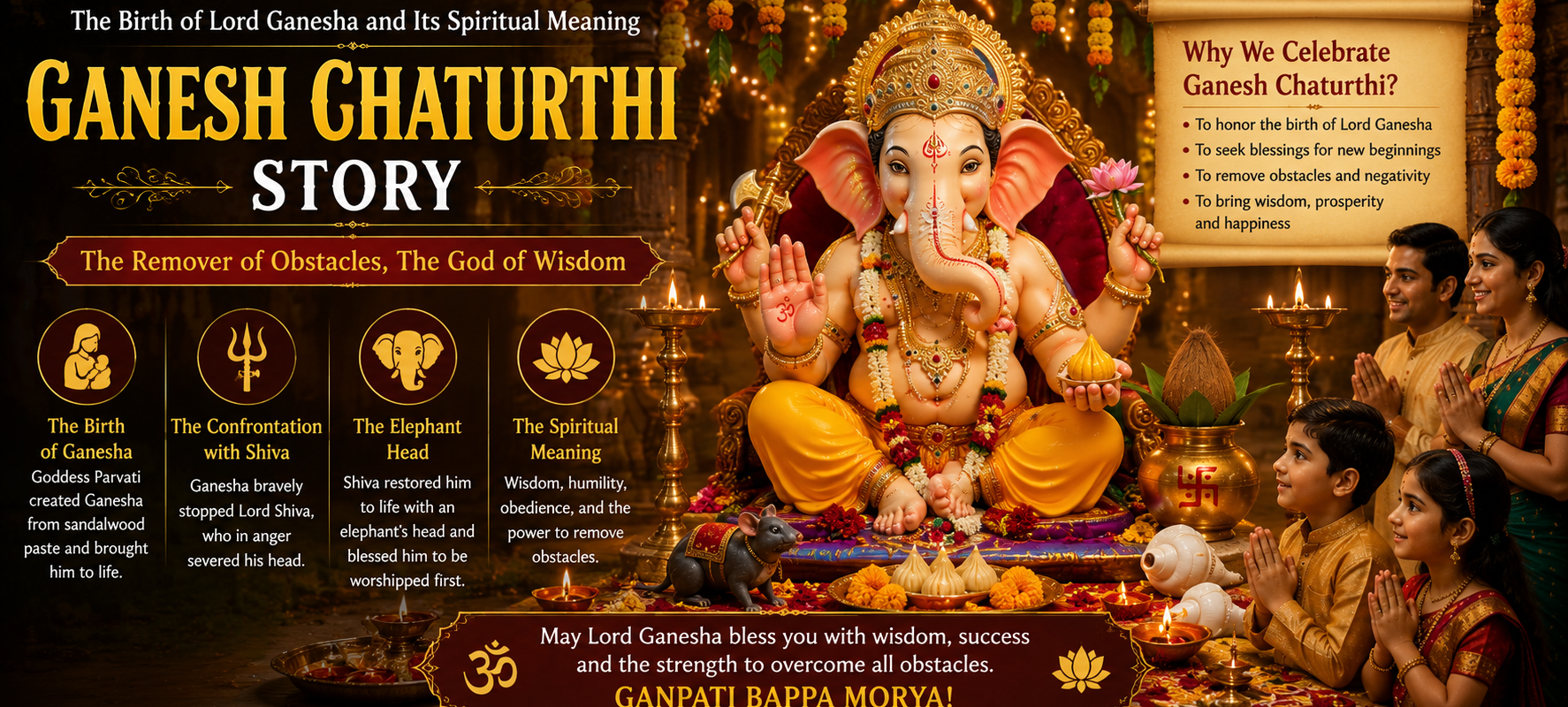
Why does Lord Ganesha have an elephant head, and why is he worshipped before every auspicious beginning? Explore the complete Ganesh Chaturthi Story, the spiritual symbolism behind Ganesha's form, and the life lessons hidden within one of Hinduism's most cherished legends.
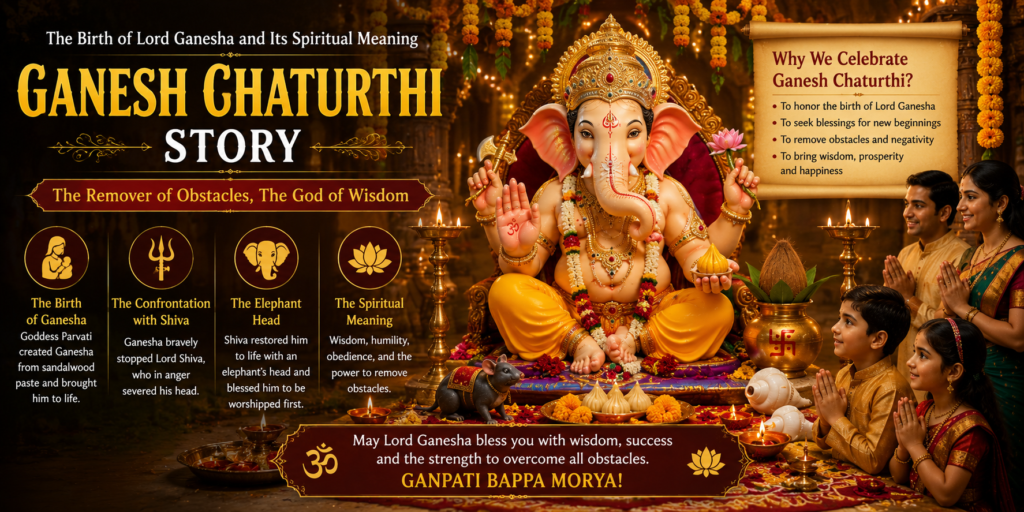
Every year, millions of devotees across India and around the world celebrate Ganesh Chaturthi with great devotion and enthusiasm. Homes and temples are decorated, prayers fill the air, and beautifully crafted idols of Lord Ganesha are welcomed with love.
But have you ever wondered why Ganesh Chaturthi is celebrated?
What is the story behind Lord Ganesha’s elephant head?
And what spiritual lessons can we learn from this beloved deity known as the Remover of Obstacles?
Let’s explore the fascinating Ganesh Chaturthi Story and uncover its deeper meaning.
Who Is Lord Ganesha?
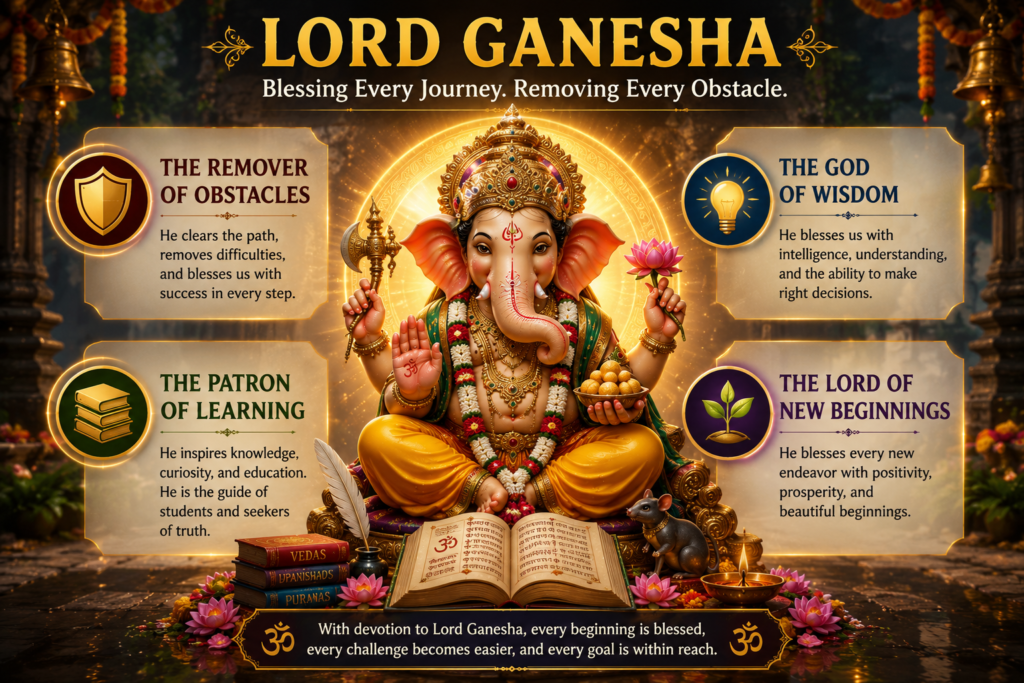
Lord Ganesha is one of the most worshipped deities in Hinduism.
Known by names such as Ganapati, Vinayaka, and Vighnaharta, He is revered as:
- The Remover of Obstacles
- The God of Wisdom
- The Patron of Learning
- The Lord of New Beginnings
For this reason, devotees invoke Lord Ganesha before starting any important task, journey, ceremony, or business venture.
The Birth of Lord Ganesha
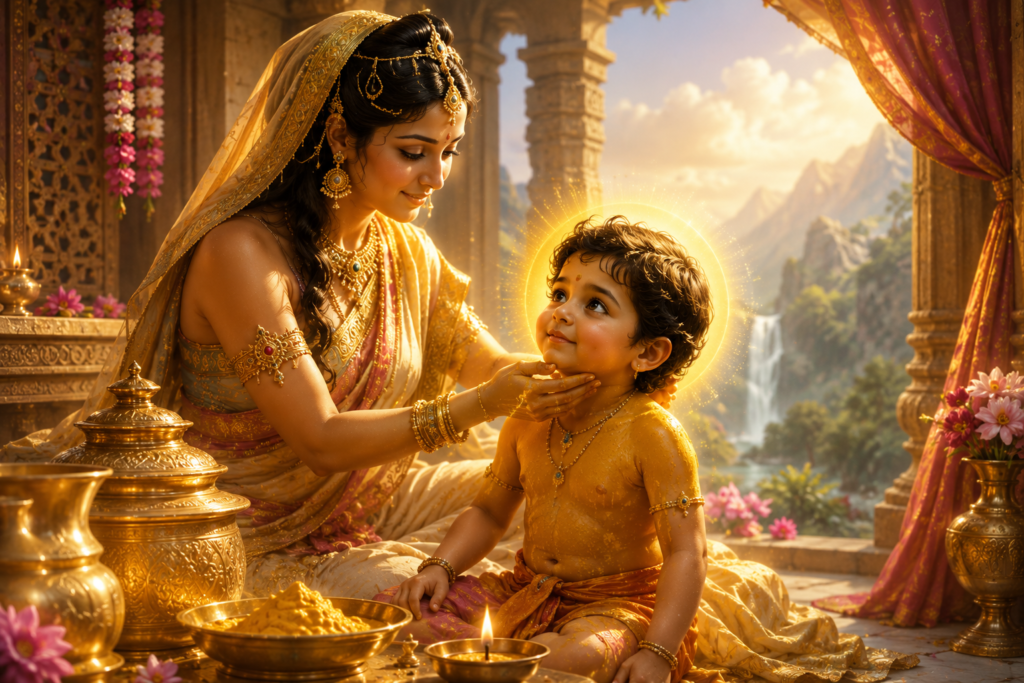
The story begins on Mount Kailash, the divine abode of Lord Shiva and Goddess Parvati.
One day, Goddess Parvati wished to bathe in privacy.
She created a young boy from the sandalwood paste (or turmeric paste according to some traditions) applied to her body.
Breathing life into him, she instructed him:
“Guard the entrance and do not allow anyone inside.”
The boy faithfully obeyed his mother’s command.
This child was Lord Ganesha.
The Confrontation with Lord Shiva
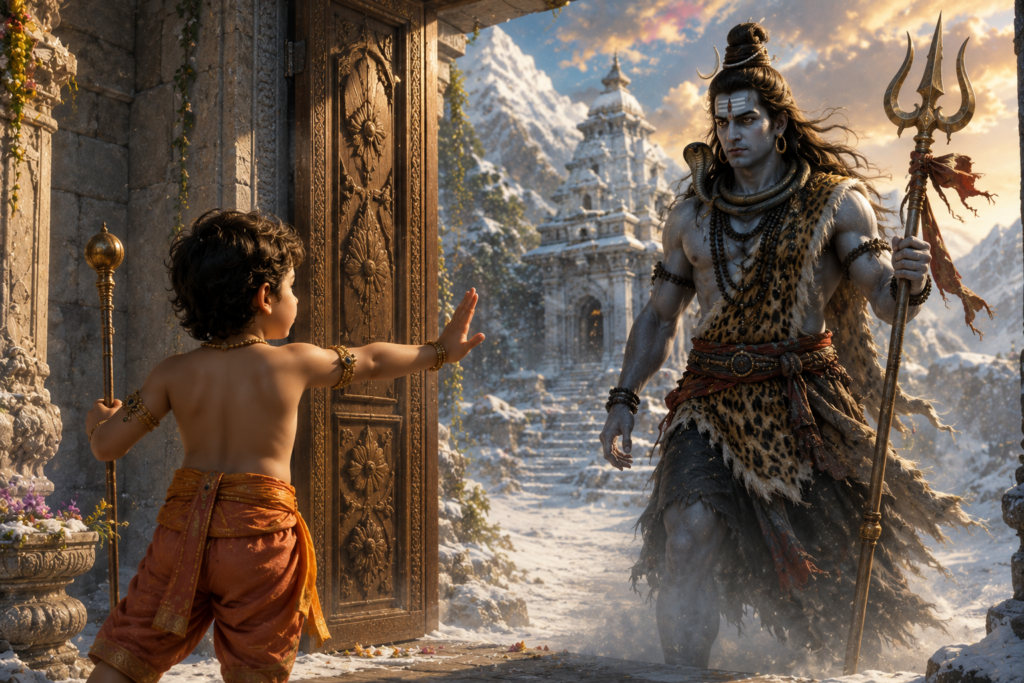
After some time, Lord Shiva returned to Kailash.
As He approached the entrance, the young boy stopped Him.
Ganesha did not know Shiva was his father.
Likewise, Shiva had never seen the boy before.
The child refused to allow Shiva to enter.
Despite repeated warnings, Ganesha remained loyal to his mother’s instructions.
A fierce confrontation followed.
The gods watched in astonishment as the young guardian stood fearlessly against Lord Shiva himself.
Finally, in anger, Shiva severed the boy’s head.
Goddess Parvati’s Grief
When Goddess Parvati emerged and saw what had happened, she was devastated.
Her sorrow quickly turned into immense anger.
According to the legends, her divine energy threatened to shake the entire universe.
The gods pleaded with Lord Shiva to restore the child to life.
Realizing the boy’s devotion and innocence, Shiva agreed.
How Lord Ganesha Received His Elephant Head
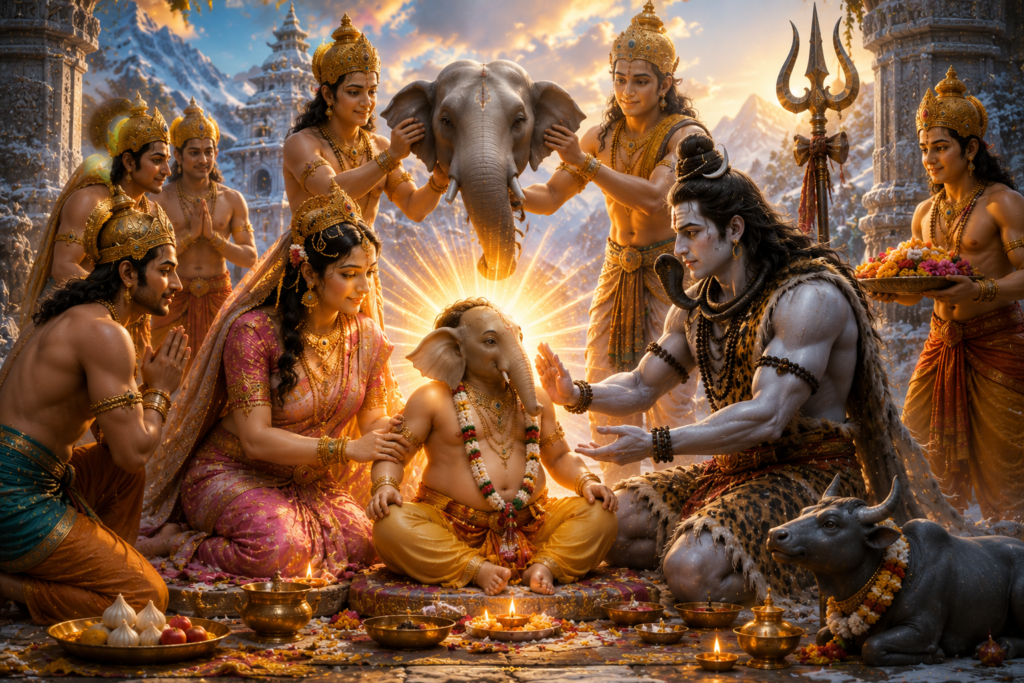
Lord Shiva instructed his followers:
“Bring me the head of the first living being you encounter facing north.”
The first creature they found was a young elephant.
The elephant’s head was respectfully brought back and attached to the child’s body.
Using divine power, Lord Shiva revived him.
The boy returned to life.
From that moment onward, he became known as Ganesha.
Lord Shiva blessed him and declared:
“You shall be worshipped before all other gods.”
This blessing is why every Hindu ritual traditionally begins with the worship of Lord Ganesha.
Why Is Ganesh Chaturthi Celebrated?
Ganesh Chaturthi marks the birth of Lord Ganesha.
The festival celebrates:
- Wisdom over ignorance
- Humility over ego
- Devotion over pride
- New beginnings
- Removal of obstacles
For devotees, the festival is an opportunity to invite positivity, success, and divine blessings into their lives.
The Spiritual Meaning Behind Ganesha’s Form
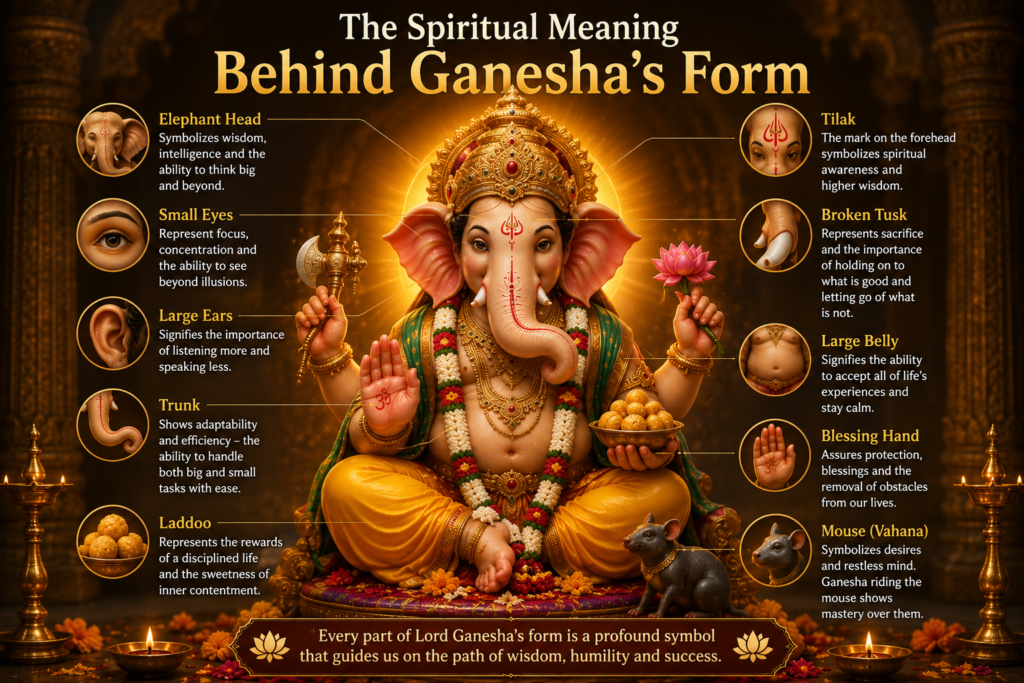
Every feature of Lord Ganesha carries symbolic meaning.
Elephant Head
The elephant head symbolizes wisdom, intelligence, and broad thinking.
Large Ears
They remind us to listen more and speak less.
Small Eyes
They represent concentration and focus.
Large Belly
It symbolizes the ability to peacefully accept life’s experiences.
Trunk
The trunk signifies adaptability and efficiency.
Mouse as a Vehicle
The mouse represents desires and impulses.
Ganesha riding the mouse symbolizes mastery over one’s mind and desires.
Life Lessons from Lord Ganesha for Modern Life
1. Obedience and Responsibility Matter
Ganesha followed his mother’s instructions without compromise.
In a world full of distractions, responsibility remains a valuable virtue.
2. Wisdom Is Greater Than Strength
Although many gods possessed immense power, Ganesha became beloved because of his wisdom.
Knowledge often achieves what force cannot.
3. Adapt to Change
After receiving an elephant head, Ganesha embraced his new identity.
Life often brings unexpected changes.
Success comes from adaptation rather than resistance.
4. Listen More Than You Speak
Ganesha’s large ears remind us of an increasingly rare skill in the digital age—listening.
Better listening leads to better relationships, better decisions, and deeper understanding.
Why Is Lord Ganesha Worshipped First?
According to Hindu tradition, Lord Shiva granted Ganesha the honor of being worshipped before all other deities.
This symbolizes the importance of removing obstacles and gaining wisdom before beginning any important undertaking.
Today, this tradition continues in:
- Weddings
- Housewarming ceremonies
- Festivals
- Business openings
- Educational pursuits
Frequently Asked Questions
Why does Lord Ganesha have an elephant head?
According to Hindu mythology, Lord Shiva restored Ganesha to life by attaching the head of an elephant after accidentally severing his original head.
Why is Ganesh Chaturthi celebrated?
Ganesh Chaturthi celebrates the birth of Lord Ganesha and honors his role as the remover of obstacles and the god of wisdom.
Why is Lord Ganesha worshipped first?
Lord Shiva blessed Ganesha with the privilege of being worshipped before all other gods.
What does Ganesha’s mouse symbolize?
The mouse represents human desires and restless thoughts. Ganesha riding the mouse symbolizes control over these impulses.
Conclusion
The Ganesh Chaturthi Story is much more than the tale of a deity receiving an elephant head.
It is a timeless lesson about wisdom, devotion, responsibility, and transformation.
Every year, as devotees welcome Lord Ganesha into their homes, they also welcome the values He represents—clarity, humility, resilience, and the courage to overcome obstacles.
May Lord Ganesha bless your life with wisdom, prosperity, and success.
Ganpati Bappa Morya!
If this story moved you, share it.
Explore more in Festival →