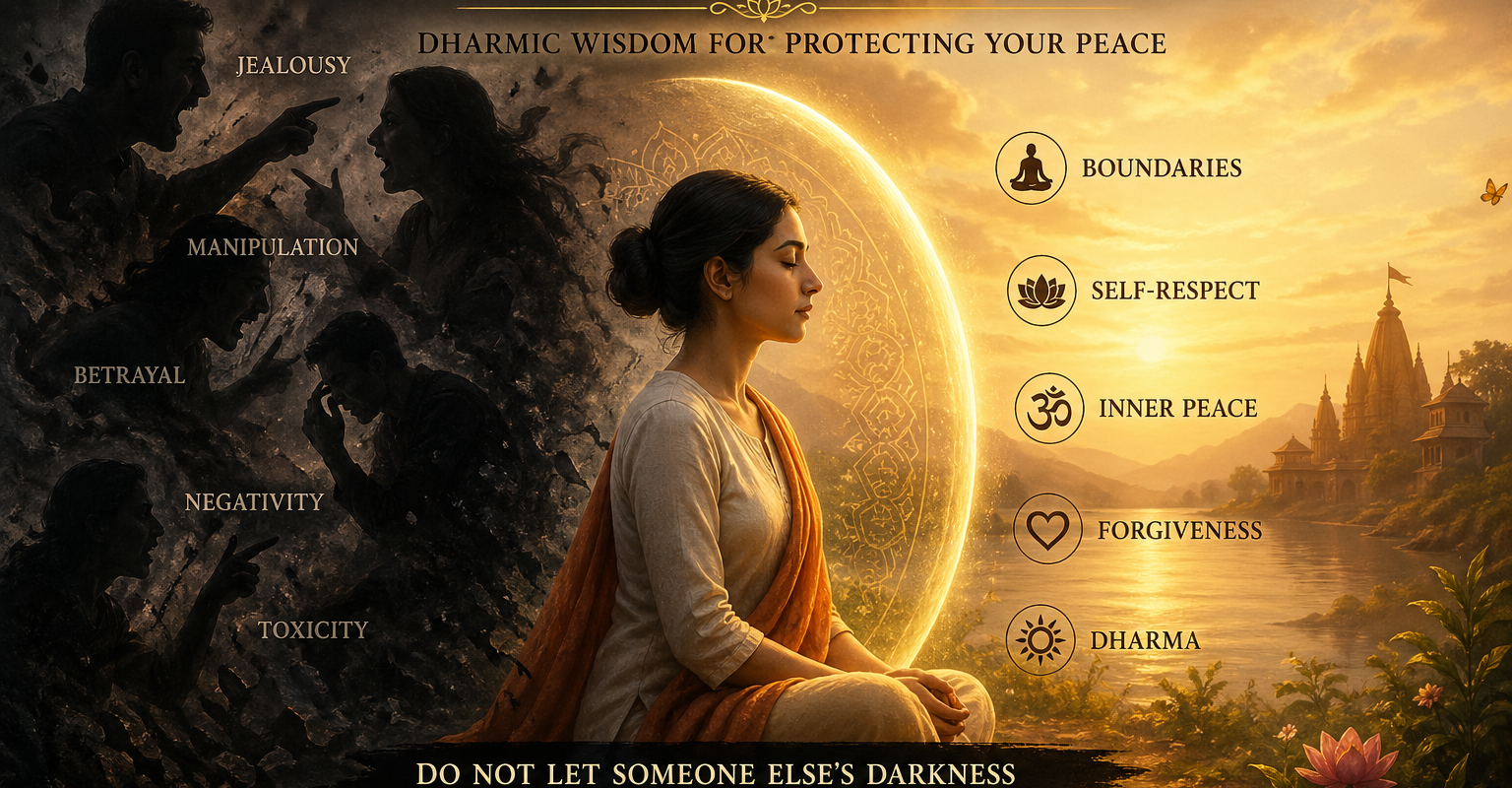
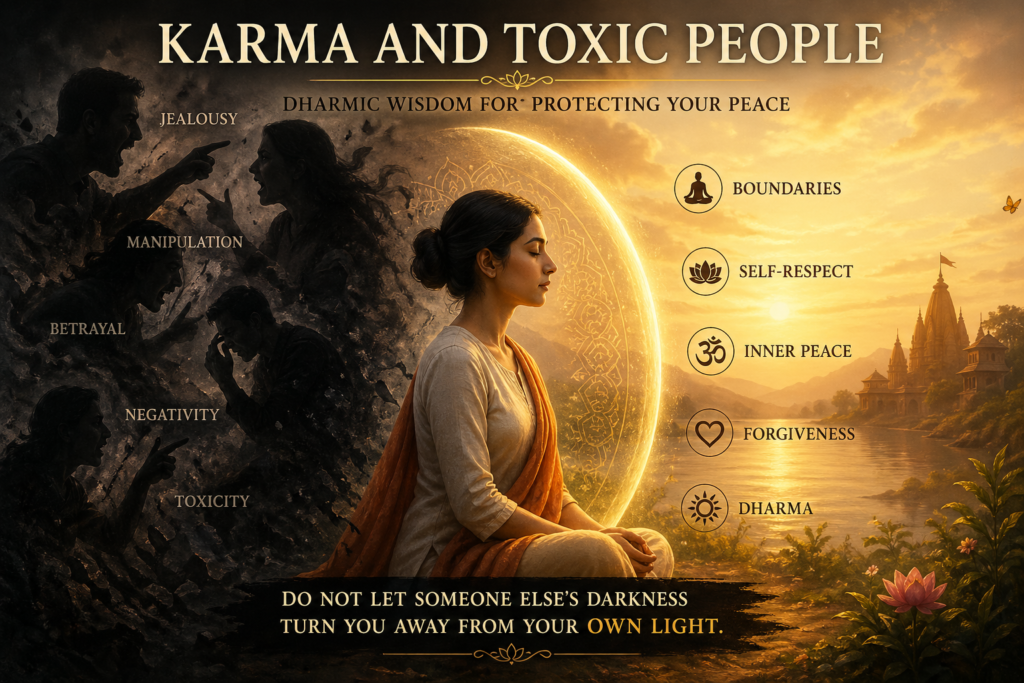
Toxic people are not always punishments sent by karma — sometimes they are lessons that teach us self-respect, emotional boundaries, and spiritual growth. Sanatan Dharma does not encourage blind tolerance of negativity in the name of kindness. Instead, it teaches balance: remain compassionate, but protect your inner peace. True spirituality means responding with wisdom, not hatred, and understanding that protecting your mental and emotional well-being is also part of Dharma.
Karma and Toxic People: What Sanatan Dharma Teaches About Protecting Your Peace
There comes a point in life when almost everyone asks the same painful question:
“Why do toxic people enter our lives?”
Sometimes it is a manipulative friend.
Sometimes a jealous relative.
Sometimes a partner who drains your peace.
And sometimes, the most difficult truth — a toxic person may even exist within our own family.
In today’s world, where relationships are becoming increasingly complicated, many people silently carry emotional exhaustion while pretending everything is normal. Social media teaches us how to “cut people off,” but ancient dharmic wisdom asks us to look deeper:
What is the karmic lesson behind these relationships?
Are we meant to tolerate them? Fight them? Forgive them? Leave them?
Sanatan Dharma does not ask us to become emotionless saints who accept abuse in the name of spirituality. At the same time, it also warns us against responding with hatred, revenge, or ego.
The path of Dharma lies somewhere in between — in awareness, boundaries, compassion, and inner strength.
What Is a “Toxic Person” According to Dharma?
Modern psychology uses the word “toxic” for people who constantly:
- manipulate,
- insult,
- emotionally control,
- disrespect boundaries,
- create negativity,
- or drain mental peace.
Ancient Indian scriptures may not use the English word “toxic,” but the concept absolutely exists.
In the Bhagavad Gita, people driven by excessive:
- anger (krodha),
- greed (lobha),
- ego (ahankara),
- jealousy (irshya),
- and selfishness
are described as moving away from dharma.
Lord Krishna explains that when negative tendencies dominate the mind, a person loses wisdom and harms both themselves and others.
Many toxic behaviors we see today are simply ancient human weaknesses appearing in modern forms.
The jealous colleague.
The constantly insulting partner.
The friend who only calls when they need help.
The relative who humiliates you publicly but acts sweet in front of society.
The faces change. Human tendencies do not.
Why Does Karma Bring Such People Into Our Lives?
This is where dharmic understanding becomes deeper than ordinary self-help advice.
Karma is not always punishment.
Sometimes karma is a lesson.
Sometimes karma is protection.
Sometimes karma is awakening.
Not every difficult person enters your life because of your “bad karma.” That is an oversimplified understanding that often creates guilt and confusion.
Sometimes toxic people appear because:
- you need to learn self-respect,
- you need stronger boundaries,
- you need emotional maturity,
- or you need to stop abandoning yourself to please others.
In many cases, the relationship itself becomes the teacher.
A person who constantly disrespects your kindness may teach you the importance of boundaries.
A manipulative friend may teach you discernment.
A betrayal may awaken spiritual strength that comfort never could.
The Mahabharata: A Timeless Example of Toxic Relationships
One of the greatest examples of toxic behavior exists in the Mahabharata itself.
The Kauravas were not strangers to the Pandavas. They were family.
Jealousy, insecurity, greed, humiliation, manipulation — these emotions poisoned the relationship long before the war of Kurukshetra began.
What is important here is that the Pandavas did not immediately choose violence. They repeatedly tried:
- patience,
- dialogue,
- compromise,
- forgiveness,
- and peace.
But Dharma also teaches something important:
Tolerating injustice endlessly is not spirituality.
There comes a point where protecting righteousness becomes necessary.
This lesson is extremely relevant today.
Many people stay in emotionally damaging relationships because society glorifies sacrifice without limits. They are told:
- “adjust more,”
- “stay quiet,”
- “family is everything,”
- “good people tolerate.”
But dharma never asks a person to destroy their inner peace to feed another person’s ego.
The Difference Between Compassion and Self-Destruction
One of the biggest misunderstandings in spirituality is believing that being “good” means accepting mistreatment silently.
True compassion does not mean becoming emotionally available for endless disrespect.
Even nature creates boundaries:
- day and night,
- land and ocean,
- birth and death.
Boundaries are part of cosmic balance.
In real life, this may look like:
- refusing constant emotional manipulation,
- limiting contact with draining people,
- saying “no” without guilt,
- walking away from repeated disrespect,
- protecting your mental health.
This does not make someone cruel.
It makes them conscious.
Karma Does Not Mean Immediate Punishment
Many people wonder:
“If karma is real, why do toxic people seem successful?”
This question has troubled human beings for centuries.
Dharmic philosophy explains karma as a long and complex process, not instant revenge.
Some people may temporarily appear powerful while still creating suffering for themselves internally:
- restless minds,
- broken relationships,
- insecurity,
- anger,
- fear,
- loneliness.
A person may win socially and still lose spiritually.
Dharma teaches us not to obsess over someone else’s punishment, because constantly waiting for revenge also disturbs our own peace.
The real focus should be:
- protecting your energy,
- acting with dignity,
- and not becoming toxic in response to toxicity.
Modern-Day Examples We See Everywhere
1. The Competitive Friend
A friend who secretly envies your growth:
- copies your work,
- discourages your dreams,
- celebrates your failures silently,
- and becomes uncomfortable when you succeed.
Such relationships are extremely common today, especially in the social media era where comparison never stops.
Dharma teaches us to observe energy carefully, not just words.
Not everyone clapping for you is happy for you.
2. Toxic Family Expectations
In many households, emotional pressure is normalized:
- career shaming,
- marriage pressure,
- constant comparison,
- guilt-based control.
Because it comes from family, people often tolerate emotional damage for years.
Respecting elders is dharma.
Destroying your mental peace is not.
Balance matters.
3. Relationships Built on Control
Sometimes a partner uses:
- emotional blackmail,
- silent treatment,
- possessiveness,
- or humiliation
in the name of “love.”
But attachment is not love.
Control is not care.
Healthy relationships create emotional safety, not constant anxiety.
What Should You Actually Do Spiritually?
Dharma is practical. It is not passive.
Here are healthier spiritual responses to toxic people:
1. Stop Trying to “Fix” Everyone
Not every soul is ready to change.
Some people only change after facing consequences.
You are responsible for your actions, not for saving everyone emotionally.
2. Protect Your Inner Energy
In Hindu traditions, mental energy is considered sacred.
That is why practices like:
- meditation,
- mantra chanting,
- silence,
- satsang,
- and prayer
are emphasized.
Your mind becomes like the company you keep.
3. Respond, Don’t React
Toxic people often feed on emotional reactions.
Remaining calm does not mean weakness.
Sometimes silence carries more strength than arguments.
4. Forgive Without Reopening the Door
Forgiveness in dharma is primarily for inner freedom.
It does not always mean:
- trusting again,
- reconnecting,
- or allowing repeated harm.
You can forgive someone internally while still maintaining distance.
What Lord Krishna’s Teachings Still Mean Today
The Bhagavad Gita is not merely a religious scripture. It is a psychological guide for human conflict.
Arjuna’s confusion on the battlefield mirrors modern emotional struggles:
- guilt,
- attachment,
- fear of hurting others,
- emotional exhaustion,
- and moral confusion.
Krishna does not tell Arjuna to escape reality.
He teaches him:
- clarity,
- emotional discipline,
- righteous action,
- and detachment from destructive attachment.
Sometimes the most spiritual thing a person can do is:
- choose peace,
- protect dignity,
- and walk away from chaos.
Final Thoughts
Toxic people are unfortunate realities of human life, but they can also become turning points in spiritual growth.
Some relationships break your heart.
Some relationships awaken your wisdom.
Karma is not simply about punishment and reward. It is about evolution of consciousness.
And perhaps the deepest lesson dharma teaches is this:
Do not let someone else’s darkness turn you away from your own light.
Protect your peace.
Stay compassionate, but not blind.
Stay kind, but not weak.
Stay spiritual, but also truthful to yourself.
Because Dharma was never meant to imprison the soul.
It was meant to liberate it.
If this story moved you, share it.
Explore more in Mythology →