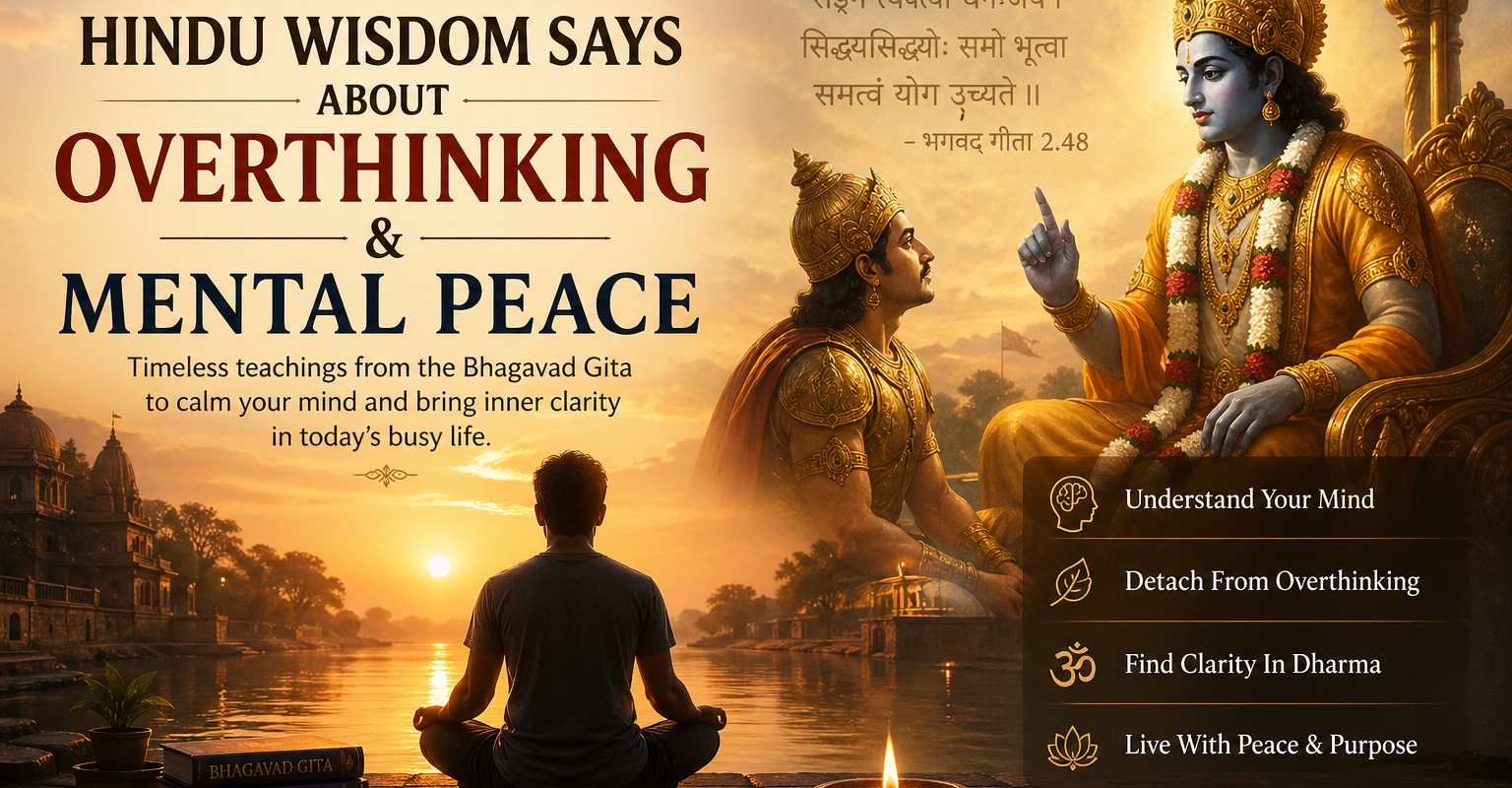
The teachings of Sanatan Dharma and the Bhagavad Gita offer timeless solutions for modern problems like overthinking, stress, and emotional burnout. By practicing detachment, mindfulness, and spiritual discipline, individuals can cultivate inner peace and mental clarity even in today’s fast-paced world.
Modern life has made the human mind restless.
Notifications never stop. Expectations keep growing. We compare our lives with others constantly. Even during moments of silence, the mind continues running endlessly between fear, regret, anxiety, and uncertainty.
Interestingly, thousands of years ago, the Bhagavad Gita described this exact condition of the human mind.
The struggle of overthinking is not new. Only the triggers have changed.
The wisdom of Sanatan Dharma offers timeless insights that are surprisingly relevant even today.
Why the Mind Keeps Overthinking
According to Hindu philosophy, the mind becomes disturbed when it gets trapped in:
- attachment to outcomes
- fear of loss
- ego-based identity
- excessive desires
- comparison with others
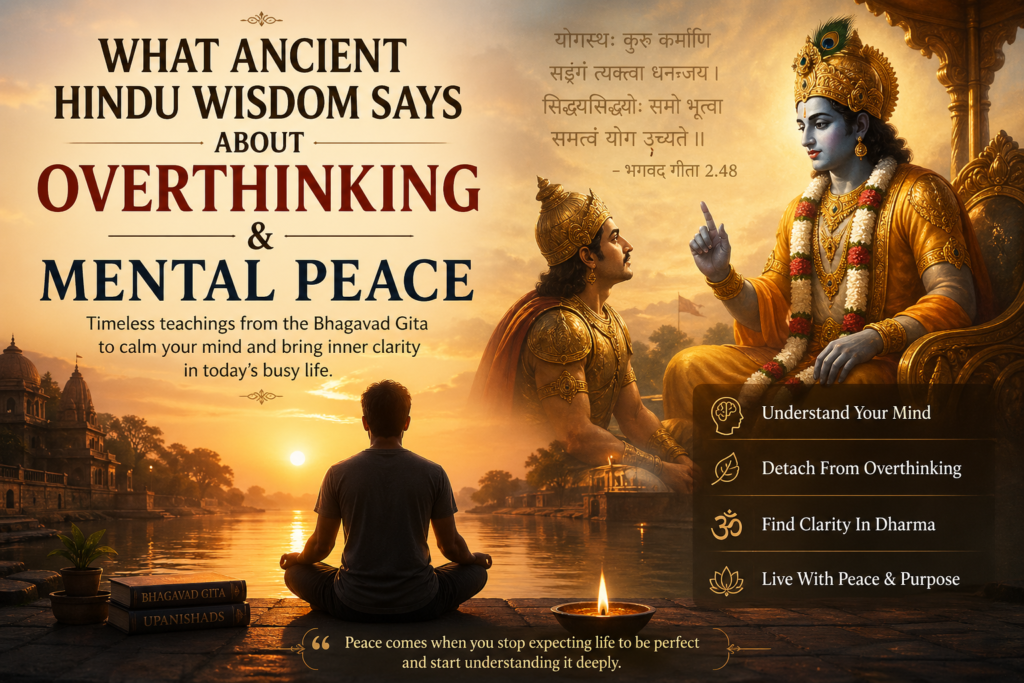
In the Bhagavad Gita, Arjuna experiences deep mental confusion before the war of Kurukshetra. He feels emotionally overwhelmed, anxious, and unable to make decisions.
This moment feels deeply relatable in modern life.
Many people today face the same inner battle:
- career confusion
- relationship stress
- fear about the future
- pressure to succeed
- emotional burnout
The battlefield has changed, but the mind remains the same.
Krishna’s Powerful Advice on Anxiety
One of the most important teachings from the Gita is:
Focus on your actions, not on the results.
This idea is known as Karma Yoga.
When people become obsessed with outcomes, the mind creates fear:
- “What if I fail?”
- “What will people think?”
- “What if things don’t go my way?”
Overthinking often begins where attachment becomes excessive.
Ancient dharmic wisdom teaches that peace comes when actions are performed sincerely, while accepting that not everything is under personal control.
This mindset reduces mental pressure dramatically.
The Spiritual Root of Overthinking
In Sanatan Dharma, overthinking is closely connected to attachment and ego.
The ego constantly seeks:
- validation
- control
- certainty
- superiority
- emotional security
But life itself is uncertain.
This conflict creates mental suffering.
The more we try to control every situation, the more anxious the mind becomes.
That is why spiritual practices focus heavily on:
- surrender
- self-awareness
- mindfulness
- detachment
- inner discipline
These are not merely religious concepts. They are tools for mental balance.
How Chanting and Meditation Calm the Mind
Ancient sages understood that the mind needs rhythm, silence, and focus.
This is why mantra chanting became an important spiritual practice.
Repeating sacred sounds such as:
- Om Namah Shivaya
- Hare Krishna
- Gayatri Mantra
helps reduce mental noise and improve concentration.
Today, even modern neuroscience studies suggest that repetitive meditative practices can help calm stress responses and improve emotional stability.
Spirituality and mental wellness are not opposites. In many ways, they support each other deeply.
What Modern Life Can Learn from Dharma
Modern culture teaches people to constantly chase:
- more success
- more validation
- more possessions
- more comparison
But dharmic wisdom asks a different question:
“What kind of inner state are you creating while chasing these things?”
A peaceful mind cannot be achieved only through external achievements.
True balance comes from:
- disciplined thoughts
- meaningful actions
- emotional detachment
- spiritual grounding
- self-awareness
This is why ancient wisdom still feels relevant even after thousands of years.
Practical Dharmic Habits for Mental Peace
Here are some simple practices inspired by Sanatan Dharma:
1. Start Your Day Early
The early morning hours, often called Brahma Muhurta, naturally support calmness and clarity.
2. Reduce Mental Consumption
Too much social media creates comparison and mental exhaustion.
3. Practice Daily Gratitude
Gratitude shifts the mind away from scarcity and negativity.
4. Chant or Meditate Daily
Even 10 minutes of silence or mantra repetition can calm the nervous system.
5. Focus on Duty, Not Constant Results
This is one of the deepest teachings of Karma Yoga.
Final Thoughts
The ancient wisdom of Sanatan Dharma was never only about rituals and temples.
It was also about understanding the human mind.
Long before modern psychology discussed anxiety and emotional stress, spiritual teachings were already guiding people toward balance, awareness, and inner peace.
Perhaps this is why these teachings continue to resonate even in today’s fast-moving digital world.
Because despite technological progress, the human search for peace remains the same.
If this story moved you, share it.
Explore more in Mythology →