Uranus Retrograde 2026 runs from September 10, 2026, to February 8, 2027, entirely in Gemini. Discover what this inward-turning transit means for communication, technology, beliefs, and the zodiac signs.
uranus-retrograde-2026-featured-image.jpg
Uranus Retrograde 2026 begins on September 10, 2026, and continues until February 8, 2027, entirely in Gemini. In astrology, Uranus is associated with freedom, innovation, disruption, originality, and sudden change. Gemini, meanwhile, is linked with communication, ideas, learning, information, networking, and the way we connect with the world.
So what happens when this restless planet appears to move backward through Gemini?
Astrologers often interpret Uranus retrograde as a period when the urge for change turns inward. Instead of immediately breaking away from an old pattern, we may start questioning why we want change in the first place. Old ideas can return for review. New technologies or communication habits may need a second look. A belief that once felt liberating may suddenly feel restrictive.
The important point is that retrograde does not mean Uranus is physically moving backward in space. Astronomically, retrograde motion is an apparent effect created by the changing perspective between Earth and a slower-moving outer planet.
Astrology gives this sky pattern a symbolic meaning. In that language, Uranus retrograde in Gemini is less about stopping progress and more about deciding which changes are actually worth keeping.
Uranus Retrograde 2026 at a Glance
| Event | Date | Position |
|---|---|---|
| Uranus enters retrograde shadow | May 25, 2026 | 1°41′ Gemini |
| Uranus turns retrograde | September 10, 2026 | 5°42′ Gemini |
| Uranus turns direct | February 8, 2027 | 1°41′ Gemini |
| Retrograde duration | About 151 days | Gemini |
| Retrograde shadow ends | May 25, 2027 | 5°42′ Gemini |
These dates are consistent across major astrology calendars. For India, Drik Panchang lists the retrograde station at approximately 11:57 PM IST on September 10, 2026, with Uranus turning direct at approximately 5:57 PM IST on February 8, 2027.
What Is Uranus?
Uranus is the seventh planet from the Sun and one of the solar system’s ice giants. NASA notes that it is roughly four times wider than Earth, takes about 84 Earth years to orbit the Sun, and has an unusual axial tilt of about 98 degrees, making it appear to rotate almost sideways. Uranus was discovered in 1781 by William Herschel.
In astrology, however, Uranus has a very different role.
Modern astrologers commonly associate Uranus with:
- freedom and independence
- innovation and invention
- rebellion against outdated structures
- breakthroughs and new possibilities
- unexpected developments
- originality and individuality
- technological and social change
Astrodienst describes Uranian symbolism in terms of radical change, liberation, unconventional thinking, invention, and sudden insight. Because Uranus takes about 84 years to travel through the zodiac, it is also considered a generational planet.
This is why Uranus transits are often felt differently from faster planetary transits. They are usually part of a longer story rather than a single-day event.
What Does Retrograde Mean in Astrology?
The word “retrograde” sounds as though a planet has suddenly changed direction.
It has not.
From Earth, an outer planet can appear to slow down, stop, and move backward against the background stars. This is called apparent retrograde motion. It is caused by the geometry of Earth’s orbit and the relative movement of the planets. Uranus continues orbiting the Sun in its normal direction.
Astrologers then interpret that apparent reversal symbolically.
Direct Uranus is often associated with outward change: breaking patterns, experimenting, disrupting routines, or trying something new.
During Uranus retrograde, astrologers often describe the process as becoming more internal. The question may shift from:
“What needs to change?”
to:
“Why am I ready for change, and what truly needs to change?”
That is why Uranus retrograde can feel quieter on the surface but surprisingly active in the mind.
Uranus Retrograde 2026 Dates
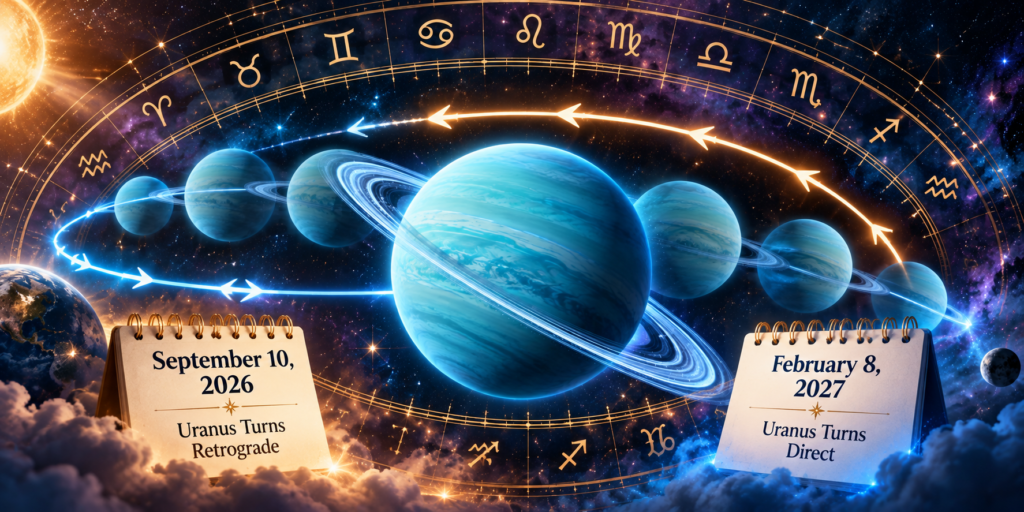
uranus-retrograde-2026-dates.jpg
The major Uranus retrograde cycle for 2026 is straightforward.
Uranus enters its retrograde shadow on May 25, 2026, reaching 1°41′ Gemini. It then reaches its retrograde station on September 10, 2026 at 5°42′ Gemini.
Uranus remains retrograde for about five months and returns to 1°41′ Gemini before turning direct on February 8, 2027.
It then continues forward through Gemini until it completes the larger shadow cycle on May 25, 2027.
The shadow period matters to astrologers because the same zodiac degrees are crossed more than once. This means a theme that first appeared during the forward journey may be revisited during retrograde and then brought to a more complete conclusion after Uranus turns direct.
Why the September 10 station matters
The station itself is often considered more noticeable symbolically because Uranus appears to slow dramatically before changing apparent direction.
In practical language, this can be treated as a pause-and-review point.
A decision made quickly earlier in the year may deserve another look. A communication pattern may no longer feel comfortable. A new digital tool may have seemed exciting at first but may now need boundaries. An old idea that was dismissed could suddenly become interesting again.
Uranus in Gemini: Why This Transit Is Different

uranus-in-gemini-2026-astrology.jpg
Uranus first entered Gemini briefly in 2025, then returned to Taurus during its retrograde. It re-entered Gemini for the longer stay in 2026. Cafe Astrology places the long-term Gemini transit beginning on April 25, 2026, continuing for several years, with some date differences depending on time zone.
The last Uranus-in-Gemini period occurred mainly between 1941 and 1949. Given Uranus’s roughly 84-year orbit, this makes the current Gemini era unusually significant from a generational astrology perspective.
Why Gemini?
Gemini is traditionally associated with:
communication, language, information, learning, media, curiosity, short-distance travel, networking, siblings, and the exchange of ideas.
Uranus brings disruption and innovation to whatever territory it enters. Astrologers therefore interpret Uranus in Gemini as a period of experimentation around how people communicate, learn, connect, and process information. Cafe Astrology specifically connects the transit with changes in education, communication systems, transportation, information exchange, and social discourse.
The retrograde phase asks us to review those changes rather than simply chase the newest one.
Effects on Communication and Technology

uranus-retrograde-communication-technology.jpg
This is one of the most interesting parts of Uranus retrograde in Gemini.
Astrologically, Gemini represents the flow of information, while Uranus is linked with technological innovation and unconventional thinking. That combination naturally draws attention to digital communication, social platforms, online learning, AI-related tools, media, transportation, and the speed at which ideas travel.
But retrograde changes the emphasis.
Instead of simply asking, “What is the next new thing?” the period is better understood as:
“Which new things are actually helping me?”
You may notice this through everyday habits.
Perhaps you are tired of constantly checking notifications.
Perhaps you discover that consuming more information is not the same as learning more.
Perhaps a new app or platform looked exciting at first but now feels distracting.
Perhaps you revisit an old course, unfinished writing project, forgotten idea, or conversation.
This is one reason Uranus retrograde in Gemini can be interpreted as a kind of mental rewiring.
The goal is not to reject technology. It is to become more intentional about how technology, information, and communication affect your attention.
A useful question for this period
Is this information helping me understand something—or simply keeping me stimulated?
That question fits Uranus in Gemini surprisingly well.
The Difference Between a Technology Forecast and an Astrological Symbol
It is tempting to read this transit as a prediction that a major technological breakthrough, internet disruption, or communication crisis must happen.
Astrology cannot establish that kind of cause-and-effect relationship.
A more useful interpretation is symbolic: Uranus in Gemini highlights the themes of information, technology, communication and mental freedom, while retrograde symbolism emphasizes reviewing and reconsidering those themes. Contemporary astrology writers similarly describe this period as a time to reassess ideas, communication patterns, and recently adopted changes.
That distinction makes the transit much more practical.
Which Zodiac Signs Are Most Discussed During Uranus Retrograde 2026?

uranus-retrograde-2026-zodiac-signs.jpg
Uranus retrograde in Gemini can be interpreted for every zodiac sign, but astrologers pay special attention to signs connected to the early degrees of Gemini.
The strongest technical emphasis falls on the mutable signs: Gemini, Sagittarius, Virgo, and Pisces, particularly when someone has a natal planet or chart angle around 1° to 6° of one of these signs. In aspect-based astrology, Uranus can form a conjunction with Gemini placements, an opposition to Sagittarius placements, and squares to Virgo and Pisces placements.
Gemini
Gemini may experience the transit most directly because Uranus is moving through the sign itself.
Themes can include identity, communication style, personal ideas, learning habits, and the need for greater intellectual freedom.
The retrograde may encourage Geminis to reconsider changes they have already started rather than constantly searching for the next new direction.
Sagittarius
Sagittarius sits opposite Gemini.
This can symbolically bring questions around beliefs, truth, relationships with different viewpoints, and the difference between having an opinion and remaining open to new information.
A belief that once felt certain may need more nuance.
Virgo
Virgo forms a square to Gemini.
Astrologers may associate this with tension between flexibility and practical systems. Work habits, routines, organization, and the way information is handled can become areas for review.
The lesson may be to create systems that are useful without becoming overly rigid.
Pisces
Pisces also forms a square to Gemini.
Here, the symbolic tension can arise between intuition and information overload.
Too much outside noise may make it harder to hear your own inner voice. The retrograde can therefore become a period for simplifying what you consume and giving yourself more mental space.
What about Libra, Aquarius, Aries and Leo?
Astrologers also look at the easier aspects.
Libra and Aquarius form trines with Gemini, while Aries and Leo form sextiles. These relationships are traditionally interpreted as creating a smoother flow for experimentation, communication, and new ideas.
However, an individual’s birth chart matters far more than a simple Sun-sign reading. A person with an exact natal placement near the Uranus station degrees can experience the transit much more personally than someone who simply happens to share the same Sun sign.
What Does Uranus Retrograde Mean Spiritually?

uranus-retrograde-spiritual-meaning.jpg
The phrase “turning inward” is particularly meaningful here.
Uranus wants freedom.
Gemini wants information.
Retrograde asks for reflection.
Together, the symbolism can become a powerful invitation to examine the ideas that quietly control our lives.
Where did this belief come from?
Do I really believe it?
Am I changing because I genuinely want something new—or because everyone around me is changing?
Am I informed, or merely overwhelmed with information?
Am I communicating what I truly mean?
Do I need more freedom, or do I simply need better boundaries?
From a spiritual perspective, the transit can be approached as a practice of discernment rather than prediction.
In a Dharmic context, this can be understood through the idea of observing the mind before reacting to it. Not every thought deserves action. Not every new idea requires immediate adoption. Not every old belief deserves to remain simply because it is familiar.
That makes Uranus retrograde less about dramatic rebellion and more about inner freedom.
How to Work With Uranus Retrograde 2026
You do not need an elaborate ritual to work with this transit.
Start by reviewing your relationship with information.
Notice how often you reach for your phone without a clear purpose. Reduce unnecessary notifications. Unsubscribe from feeds that create noise rather than value.
Then look at ideas you started earlier in 2026.
Which ones still excite you?
Which ones were simply reactions to trends?
Which ones deserve a second attempt?
Communication is another important area.
A conversation left unfinished may become relevant again. A misunderstanding may become easier to see with more distance. An old connection may return. Before reacting, slow down enough to ask what you actually want to communicate.
Journaling can also be especially useful during this transit.
A simple three-question journal works well:
What am I questioning?
What am I ready to rethink?
What kind of freedom do I actually want?
You can also create a personal “digital reset” during the retrograde.
Clean up your email subscriptions.
Back up important files.
Organize your notes.
Review the apps you use.
Delete digital clutter.
Return to unfinished writing, study, creative projects, or ideas that still have life in them.
The purpose is not to become anti-technology. It is to become more conscious about technology.
Should You Avoid Making Major Decisions During Uranus Retrograde?
Astrology does not require everyone to stop making decisions during retrograde periods.
A better approach is to be especially thoughtful around choices involving sudden rebellion, impulsive communication, or major changes made simply because you feel restless.
Uranus is already associated with unpredictability. During the retrograde, the symbolic emphasis is more reflective.
So rather than asking:
“Should I do nothing?”
ask:
“Have I understood what I am changing—and why?”
That small difference can make the transit much more useful.
A Simple Uranus Retrograde Practice
For five minutes a day, sit quietly without your phone.
Take a few slow breaths and allow thoughts to come and go.
Then write down one idea that keeps returning.
Do not decide whether the idea is good or bad.
Simply observe it.
At the end of the week, review what you wrote.
You may start to notice a pattern: perhaps the same desire for freedom keeps appearing, or perhaps the same habit repeatedly drains your attention.
That awareness is where the “inner revolution” begins.
Final Thoughts
Uranus Retrograde 2026 is not necessarily about chaos. It is about becoming more conscious of change.
With Uranus moving through Gemini, the themes are especially connected with communication, information, learning, technology, ideas, and the ways we connect with one another.
From September 10, 2026 to February 8, 2027, astrologers interpret the retrograde as a chance to revisit those areas from a more reflective position.
You may discover that an idea you once rejected deserves another look.
You may realize that a habit that felt modern is actually exhausting.
You may change your mind about something you were once certain about.
And you may discover that real freedom is not always about breaking away.
Sometimes, it is simply about thinking for yourself.
Frequently Asked Questions About Uranus Retrograde 2026
When is Uranus retrograde in 2026?
Uranus is retrograde from September 10, 2026, to February 8, 2027, in Gemini. It stations retrograde at approximately 5°42′ Gemini and turns direct at approximately 1°41′ Gemini.
What does Uranus retrograde mean in astrology?
Astrologers generally interpret Uranus retrograde as a period when themes of freedom, change, individuality, and disruption become more internal. It can be a time to reconsider changes already underway.
What does Uranus in Gemini mean?
Uranus in Gemini is commonly associated with innovation in communication, learning, information exchange, transportation, networking, and technology.
Which zodiac signs are most affected by Uranus retrograde 2026?
The signs most closely watched from an aspect-based perspective are Gemini, Sagittarius, Virgo, and Pisces, especially when natal planets or angles fall around 1° to 6° of those signs.
Is Uranus retrograde bad luck?
Astrology does not require retrograde periods to be treated as “bad luck.” The symbolism is better understood as a period of review, adjustment, experimentation, and deeper awareness.
What should I do during Uranus retrograde?
Review your communication habits, digital routines, beliefs, unfinished ideas, and recent changes. Give yourself room to rethink before making impulsive changes simply because something feels restrictive.
If this story moved you, share it.
Explore more in Astrology & Panchang →