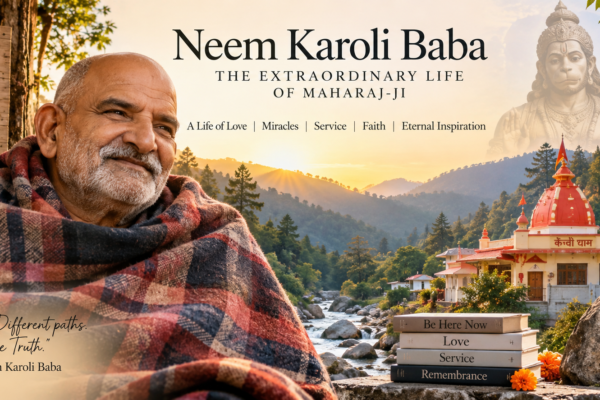
Why do Neem Karoli Baba’s teachings still matter today? Explore how his simple message of love, seva, truth, and devotion offers meaningful guidance to a generation growing up in a digital and constantly changing world.

neem-karoli-baba-teachings-new-generation.jpg
Neem Karoli Baba, affectionately known by devotees as Maharaj-ji, left the physical world in 1973. Yet more than five decades later, his name continues to attract spiritual seekers, young visitors and people searching for something deeper than material success.
His teachings were remarkably simple. Love everyone. Serve everyone. Feed people. Remember God. Tell the truth.
At first glance, these words may seem traditional or even old-fashioned in an age dominated by smartphones, artificial intelligence, social media, career competition and constant notifications. But perhaps that simplicity is precisely why Neem Karoli Baba’s teachings continue to speak to the modern mind.
Today’s generation has unprecedented access to information but often struggles with something information cannot provide: inner direction.
The World Health Organization reported in 2025 that approximately one in six people worldwide experience loneliness, with adolescents and young adults among the groups most affected. The WHO also highlighted the importance of meaningful human connection and warned that digital environments can sometimes contribute to disconnection.
Against this background, Neem Karoli Baba’s emphasis on love, service, community, humility and remembrance offers an interesting spiritual perspective.
His teachings do not provide a technological solution to modern problems. Instead, they ask a more fundamental question:
How should we live when the world around us keeps becoming faster?
Who Was Neem Karoli Baba?
who-was-neem-karoli-baba-kainchi-dham.jpg
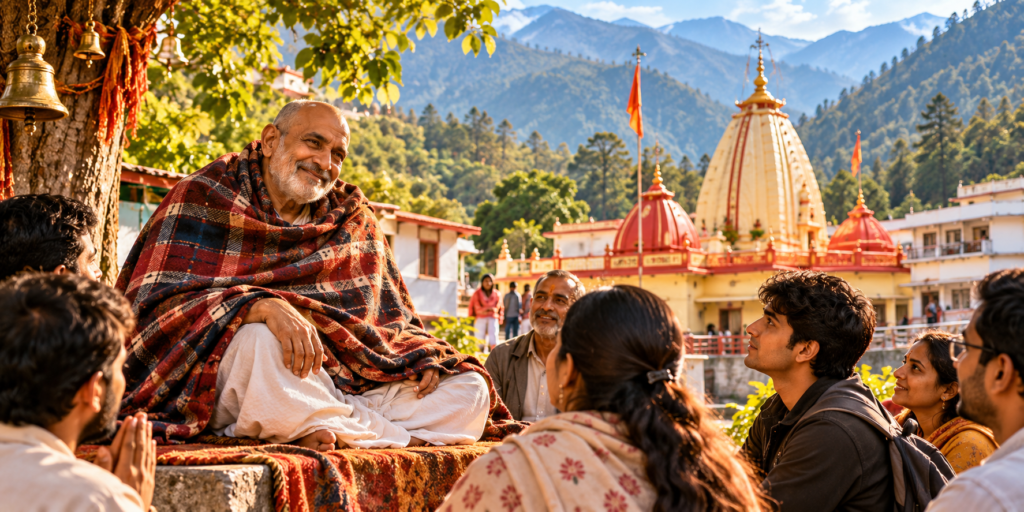
Neem Karoli Baba, also spelled Neeb Karori Baba, was a Hindu saint and devotee of Lord Hanuman who became especially associated with Kainchi Dham in Uttarakhand.
Kainchi Dham is officially recognised as a pilgrimage centre in Uttarakhand. The state tourism department describes it as a Hanuman temple and ashram founded by Neem Karoli Baba, while the district administration lists it as a major religious destination near Nainital.
Baba did not leave behind a formal philosophical system or a large body of written teachings. Much of what is known about his spiritual guidance comes through devotees, disciples and recollections.
One of the most important sources is Miracle of Love: Stories about Neem Karoli Baba, compiled by Ram Dass from accounts shared by devotees. The book itself acknowledges that these stories are recollections and that their factual accuracy cannot always be independently established.
This distinction is important.
Neem Karoli Baba’s legacy contains both historical material and devotional tradition. Stories about miracles belong primarily to the latter category and should be understood as matters of faith rather than scientifically established events.
But his practical teachings about love, service and devotion have had a demonstrable influence on generations of followers.
His best-known Western disciple, Richard Alpert—later known as Ram Dass—met him in India in 1967. Ram Dass subsequently became an important figure in bringing Indian spiritual ideas to Western audiences through teachings and books including Be Here Now.
And that bridge between an Indian saint of the twentieth century and seekers around the world is one reason his teachings remain relevant today.
What Were the Main Teachings of Neem Karoli Baba?
Although different sources phrase his teachings differently, several themes repeatedly appear in the tradition surrounding Maharaj-ji.
1. Love Everyone
Perhaps the most famous teaching associated with Neem Karoli Baba is:
Love everyone.
This does not necessarily mean agreeing with everyone or allowing people to treat us badly.
Rather, it points toward seeing the basic dignity of another person before judging them by their appearance, wealth, social position, profession, religion or background.
The Love Serve Remember Foundation, which preserves the teachings of Ram Dass and Neem Karoli Baba, expresses this principle as respecting the inherent dignity and value of every person and avoiding prejudice and premature judgment.
Why does this matter to young people today?
Modern life can make comparison almost unavoidable.
Social media encourages people to compare:
- careers
- salaries
- relationships
- appearance
- holidays
- homes
- possessions
- achievements
- popularity
A person’s online profile can become a carefully edited version of their life.
Neem Karoli Baba’s teaching offers a radically different starting point:
A person’s value does not depend on their social image.
Imagine applying that principle to social media.
Instead of asking:
“Why does everyone seem more successful than me?”
one might begin asking:
“Can I appreciate another person’s happiness without using it as evidence that my own life is inadequate?”
That is a very modern application of an old spiritual principle.
2. Serve Everyone

neem-karoli-baba-serve-everyone-seva.jpg
Neem Karoli Baba’s teaching was not simply about feeling love internally.
Love was supposed to become action.
Ram Dass repeatedly described Maharaj-ji’s emphasis on selfless service. According to Ram Dass’s account, Baba encouraged householders to practise karma yoga—turning ordinary life and work into a form of devoted service rather than insisting that spirituality required withdrawing from everyday responsibilities.
This idea is particularly relevant to today’s generation.
A young person does not necessarily need to abandon a career, move to an ashram or spend hours in meditation to explore spirituality.
Service can happen through ordinary life.
A student can help a struggling classmate.
A professional can mentor someone junior.
A family can care for an elderly relative.
A person can volunteer.
Someone can simply listen to a friend who is going through a difficult period.
Even small acts count.
The deeper lesson is:
Spirituality is not only what happens during prayer. It is also how we behave toward other people.
3. Feed Everyone
Another important part of Neem Karoli Baba’s tradition is feeding others.
The Kainchi Dham tradition continues to associate Maharaj-ji with hospitality, food and service. His teachings are often remembered through the simple expression:
Love all, serve all, feed all, remember God.
There is something remarkably practical about this teaching.
Food is one of the most basic forms of human care.
You do not need philosophical knowledge to understand hunger.
You do not need to know someone’s background to offer them a meal.
And you do not need to agree with someone before treating them with kindness.
For today’s generation, “feed everyone” can also be understood more broadly as developing a culture of generosity.
It could mean:
- sharing food
- supporting community kitchens
- helping someone experiencing financial difficulty
- donating responsibly
- reducing food waste
- helping animals
- supporting people who are vulnerable
In a world where spirituality is sometimes presented as an individual search for personal peace, Neem Karoli Baba’s tradition reminds us that spirituality can also be profoundly social.
4. Remember God
The fourth major theme is remembrance of God.
For devotees, this includes practices such as remembering the Divine Name and maintaining awareness of God during everyday activities.
This is particularly interesting in the context of modern attention.
Today’s digital environment is designed around interruption.
A notification appears.
A message arrives.
Another video starts.
A new headline appears.
Someone posts an update.
The mind constantly moves from one stimulus to another.
Neem Karoli Baba’s emphasis on remembrance points in the opposite direction: develop an inner anchor that is not completely dependent on whatever is happening outside you.
For a devotee, that anchor may be Ram Naam, Hanuman devotion, prayer or mantra.
For someone exploring spirituality more broadly, it can also mean deliberately creating moments of stillness and remembering what gives life meaning.
This does not make smartphones or technology inherently bad.
The question is whether technology controls our attention—or whether we can consciously decide where our attention goes.
5. Tell the Truth
The Neem Karoli Baba tradition is also associated with truthfulness.
The Love Serve Remember Foundation summarises the teaching through four principles:
Love Everyone.
Serve Everyone.
Tell the Truth.
Remember the Divine Unity of All Creation.
Truthfulness may be more difficult—and more important—in the age of social media.
Today, people can carefully construct their public identity.
A person can appear successful while struggling privately.
They can appear happy while feeling lonely.
They can appear confident while experiencing fear.
They can present perfection while dealing with ordinary human problems.
The teaching of truthfulness does not mean sharing every private detail with the internet.
It means becoming more honest with ourselves.
Ask:
What am I actually feeling?
What am I really trying to prove?
Am I pursuing this goal because it matters to me, or because I want other people to admire me?
That kind of self-honesty can be a powerful form of spiritual practice.
6. Simplicity Can Be a Form of Freedom
Neem Karoli Baba was known for his extremely simple appearance and lifestyle.
His famous woollen blanket became part of his visual identity, but the deeper symbolism of his life was his apparent lack of interest in conventional displays of status.
This has an intriguing relevance in today’s consumer culture.
Modern advertising constantly tells us that happiness is one purchase away.
A better phone.
A bigger house.
Better clothes.
A newer car.
Another holiday.
Another cosmetic product.
Another upgrade.
There is nothing inherently wrong with enjoying material things.
The problem begins when consumption becomes the primary measure of success.
Neem Karoli Baba’s life presents a different idea:
You can have things without allowing things to define you.
For the younger generation, simplicity does not have to mean rejecting modern life.
It can mean learning the difference between:
“I want this.”
and
“I need this in order to feel worthy.”
That distinction can change the way we approach money, possessions and success.
7. Spirituality Does Not Have to Mean Escaping Everyday Life
One of the most interesting aspects of Neem Karoli Baba’s teaching is that spirituality was not necessarily presented as an escape from ordinary responsibilities.
Ram Dass described Baba’s approach to householders as one that emphasised karma yoga and service through everyday life. The work itself could become spiritual practice when performed with remembrance and devotion.
That idea is highly relevant to today’s generation.
You can practise spirituality while:
- going to work
- raising children
- studying
- running a business
- cooking
- cleaning
- caring for parents
- helping colleagues
- paying bills
- dealing with difficult people
The spiritual question becomes:
How am I doing these things?
With constant resentment?
With ego?
With greed?
With awareness?
With gratitude?
With service?
This turns ordinary life into the place where spiritual practice happens.
8. His Teachings Offer an Alternative to the Culture of Constant Comparison
One of the biggest pressures faced by younger people is comparison.
Social media makes it possible to compare ourselves with thousands of people before breakfast.
Someone has a better job.
Someone looks younger.
Someone has more followers.
Someone bought a house.
Someone got married.
Someone travelled to Europe.
Someone launched a business.
Someone seems to have figured out life.
But we rarely see the complete story behind the photograph.
Neem Karoli Baba’s teachings shift attention away from external comparison toward inner qualities:
Am I becoming more loving?
Am I becoming more truthful?
Am I helping someone?
Am I becoming less judgmental?
Am I remembering what truly matters?
These are very different measurements of success.
And unlike follower counts, they cannot be easily displayed on an Instagram profile.
9. His Teaching of Service Addresses the Problem of Loneliness
neem-karoli-baba-service-community-loneliness.jpg
This may be one of the most striking connections between Neem Karoli Baba’s teachings and contemporary life.
The WHO Commission on Social Connection reported in 2025 that approximately 17–21% of people aged 13–29 reported loneliness, with adolescents and young adults among the groups most affected. The WHO also recommends everyday actions such as reaching out to friends, being fully present in conversation, joining groups and volunteering as ways of strengthening social connection.
Notice the overlap.
Neem Karoli Baba’s message:
Serve others.
Modern social-health research:
Build meaningful human connection.
These are not identical ideas, and one should not claim that modern research proves Neem Karoli Baba’s spiritual philosophy.
But there is a meaningful practical intersection.
Serving another person requires us to move beyond ourselves.
We have to notice someone else.
Listen to someone else.
Help someone else.
Care about someone else’s experience.
That can create exactly the kind of human connection that many people increasingly struggle to find.
10. “Be Here Now” and the Modern Attention Crisis

be-here-now-neem-karoli-baba-modern-attention-crisis.jpg
Neem Karoli Baba’s influence also reached younger generations indirectly through Ram Dass.
After meeting Maharaj-ji in 1967, Richard Alpert became Ram Dass, and his 1971 book Be Here Now became an influential introduction to meditation, yoga and Eastern spirituality for Western audiences.
The phrase “Be Here Now” has an almost startling relevance in an age of constant digital distraction.
Think about how often we are physically in one place while mentally somewhere else.
We eat while scrolling.
We watch television while checking messages.
We speak to someone while thinking about another task.
We attend a meeting while reading notifications.
We go on holiday while documenting every moment.
Being present does not mean abandoning technology.
It means recovering the ability to give something our complete attention.
And that may be one of the simplest spiritual practices available to modern people.
11. His Message Does Not Require Young People to Abandon Modern Life
This point is worth emphasising.
Neem Karoli Baba’s teachings should not be interpreted as a demand that young people reject technology, careers, education or ambition.
A modern spiritual life can include:
- technology
- entrepreneurship
- scientific education
- professional ambition
- social media
- travel
- modern medicine
- artificial intelligence
The question is not whether we use these things.
The deeper question is:
Do these things serve human life, or do we become servants of them?
A young entrepreneur can practise service.
A software developer can practise integrity.
A content creator can practise truthfulness.
A student can practise compassion.
A doctor can practise seva.
A parent can practise unconditional love.
Spirituality can exist inside modern life.
12. Why Are Young People Rediscovering Neem Karoli Baba?
There are signs that interest in Neem Karoli Baba is not simply a nostalgic attachment to an older saint.
In 2026, The Indian Express reported a significant resurgence of interest in Neem Karoli Baba and Kainchi Dham, including growing numbers of younger visitors and social-media-driven interest. The report also noted the continuing global influence of disciples such as Ram Dass, Krishna Das and Larry Brilliant.
The official Uttarakhand tourism site also identifies Kainchi Dham as an important pilgrimage destination and notes its association with figures such as Steve Jobs and Mark Zuckerberg, whose visits helped bring wider international attention to the site.
But celebrity associations alone cannot explain spiritual relevance.
The deeper reason may be that his message is unusually uncomplicated.
A young person overwhelmed by thousands of opinions can understand:
Love someone.
A person searching for purpose can understand:
Serve someone.
Someone feeling disconnected can understand:
Connect with another human being.
Someone caught in endless consumption can understand:
Live simply.
Someone overwhelmed by distractions can understand:
Remember God.
And someone confused about how to live can begin with:
Tell the truth.
What Can the New Generation Learn From Neem Karoli Baba?
Instead of treating his teachings merely as quotations to post online, they can be converted into everyday practices.
A simple modern interpretation could look like this:
| Neem Karoli Baba’s teaching | Modern application |
|---|---|
| Love everyone | Reduce unnecessary judgment |
| Serve everyone | Help someone without expecting recognition |
| Feed everyone | Share food and support those in need |
| Remember God | Create moments of prayer, mantra or silence |
| Tell the truth | Be honest with yourself and others |
| Live simply | Separate genuine needs from endless consumption |
| Practise devotion | Make spirituality part of daily life |
| Serve through work | Bring integrity and care into your profession |
| See the Divine in others | Treat people with dignity |
| Stay present | Give people and tasks your full attention |
This is where the teachings become more than history.
They become practice.
A 5-Minute Neem Karoli Baba-Inspired Practice for Modern Life
Someone does not have to spend hours meditating to begin.
Try this simple five-minute routine:
Minute 1: Become still
Put the phone away.
Sit quietly.
Take a few slow breaths.
Minute 2: Remember
Repeat a Divine Name that has meaning for you.
For devotees of Neem Karoli Baba, this may be:
“Ram Ram”
or
“Shri Ram Jai Ram Jai Jai Ram.”
Minute 3: Reflect
Ask yourself:
“Whom can I help today?”
It could be a family member, colleague, neighbour, friend or stranger.
Minute 4: Practise gratitude
Think of three things you already have rather than three things you want.
Minute 5: Make one small commitment
Choose one action:
- speak kindly
- help someone
- feed someone
- forgive someone
- listen without interrupting
- tell the truth
- avoid unnecessary judgment
Then return to ordinary life.
The important thing is not the length of the practice.
It is whether the practice changes the way we live.
Neem Karoli Baba’s Message in the Age of Artificial Intelligence
There is another reason his teachings may become increasingly interesting in the coming years.
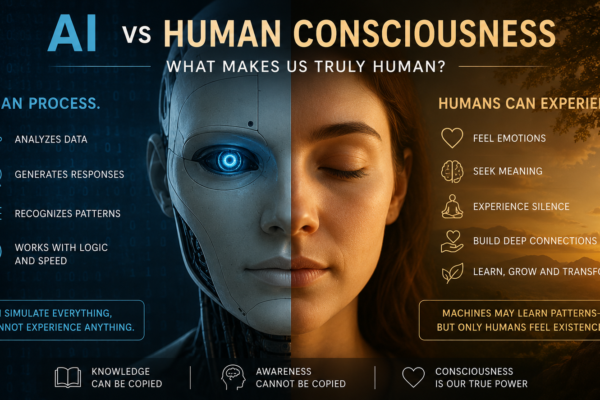
Artificial intelligence can generate information, images, music, videos and even convincing conversations.
Technology can make life more efficient.
But it cannot automatically answer questions such as:
What is worth doing?
What kind of person should I become?
What does a meaningful life look like?
How should I treat another human being?
Those are ethical and spiritual questions.
Neem Karoli Baba’s teachings do not provide a technical manual for artificial intelligence.
They provide something different: a human-centred framework based on love, service, humility, truthfulness and remembrance.
In a world becoming increasingly automated, those qualities may become more—not less—valuable.
The Real Meaning of “Love, Serve, Remember”

love-serve-remember-neem-karoli-baba.jpg
Perhaps the most powerful way to understand Neem Karoli Baba’s legacy is not as a collection of mystical sayings but as a sequence:
Love → Serve → Remember.
Love changes how we see people.
Service changes how we behave toward them.
Remembrance changes what we keep at the centre of our lives.
And truthfulness keeps the entire process grounded.
The Love Serve Remember Foundation continues to preserve and share these teachings through digital archives, podcasts, online communities and programmes, including a Young Adult Satsang specifically designed for people aged 17–25.
That itself demonstrates something important.
The teachings have not remained confined to an old book or a Himalayan ashram.
They are being carried into contemporary forms of community and communication.
Final Thoughts: Why Neem Karoli Baba Still Matters
Neem Karoli Baba lived in a very different world from the one today’s generation knows.
There were no smartphones.
No social media.
No artificial intelligence.
No endless notifications.
No algorithm deciding what people should watch next.
Yet his central questions remain surprisingly contemporary.
How do we treat other people?
Can we serve without expecting applause?
Can we remain humble when the world encourages self-promotion?
Can we distinguish what we genuinely need from what we are constantly being told to desire?
Can we remain connected to something deeper than our online identity?
Can we remember God while living an ordinary life?
Perhaps this is why Neem Karoli Baba’s teachings continue to attract people decades after his passing.
His message does not require us to escape the modern world.
It asks us to change the way we move through it.
Love everyone.
Serve everyone.
Feed those who are hungry.
Tell the truth.
Remember God.
And perhaps, in a world that is becoming increasingly connected technologically while many people feel increasingly disconnected personally, that very simple message has never been more worth remembering.
The world may change its technology, fashion and language. But the human need for love, meaning, connection and compassion does not change nearly as quickly.
That may be the enduring relevance of Neem Karoli Baba.
Frequently Asked Questions
What was Neem Karoli Baba’s main teaching?
Neem Karoli Baba’s teachings are commonly summarised around love, selfless service, feeding others, devotion and remembrance of God. The Ram Dass tradition also preserves the principles “Love Everyone, Serve Everyone, Tell the Truth, and Remember the Divine Unity of All Creation.”
Why is Neem Karoli Baba relevant to today’s generation?
His teachings address issues that remain relevant in modern life, including loneliness, excessive comparison, materialism, lack of meaningful connection and the search for purpose. Contemporary research, including the WHO’s 2025 report on social connection, highlights the importance of meaningful relationships and community, although this research should not be presented as scientific proof of his spiritual teachings.
What does “Love Everyone, Serve Everyone” mean?
It can be understood as treating people with dignity and compassion while turning spiritual values into practical action. In the Ram Dass tradition, service is closely connected with karma yoga—the idea that everyday work and action can become a form of spiritual practice.
Was Neem Karoli Baba connected with Ram Dass?
Yes. Ram Dass, formerly Richard Alpert, travelled to India in 1967 and met Neem Karoli Baba. He later became one of the major figures through whom Maharaj-ji’s influence reached Western spiritual seekers.
Is Kainchi Dham still active today?
Yes. Kainchi Dham remains an active pilgrimage centre in Uttarakhand and is officially recognised by government tourism authorities. Recent reporting has also described a major resurgence of visitors and interest among younger people.
Did Neem Karoli Baba write books about his teachings?
Neem Karoli Baba did not leave behind a systematic authored body of teachings comparable to a philosophical treatise. Much of his teaching has been preserved through devotees and disciples. Miracle of Love, compiled by Ram Dass, is one of the major collections of stories and recollections about him.
Are the miracles associated with Neem Karoli Baba historically proven?
Miracle stories form an important part of devotional tradition surrounding Maharaj-ji, but they should be presented as faith-based or testimonial accounts rather than independently verified scientific facts. Even Ram Dass’s compilation acknowledges uncertainty about the factual accuracy of individual stories.
What is the simplest way to practise Neem Karoli Baba’s teachings?
Begin with one small action each day: be kind to someone, serve without expecting recognition, share food, practise truthful self-reflection, spend a few quiet minutes in prayer or remembrance, and reduce unnecessary judgment of others.
Conclusion
Neem Karoli Baba’s teachings remain relevant not because the modern world is identical to the world in which he lived, but because the fundamental human questions remain remarkably similar.
Technology can change how we communicate.
It cannot replace love.
Career opportunities can change how we work.
They cannot by themselves provide meaning.
Social media can increase our connections.
It cannot guarantee that those connections will be meaningful.
And artificial intelligence can transform how we access information.
It cannot decide what is truly worth remembering.
For a new generation searching for a deeper way to live, Neem Karoli Baba’s message remains wonderfully simple:
Love. Serve. Tell the truth. Remember God.
Sometimes the oldest wisdom does not need to become modern.
It simply needs to be lived.
If this story moved you, share it.
Explore more in Digital Age Spirituality →