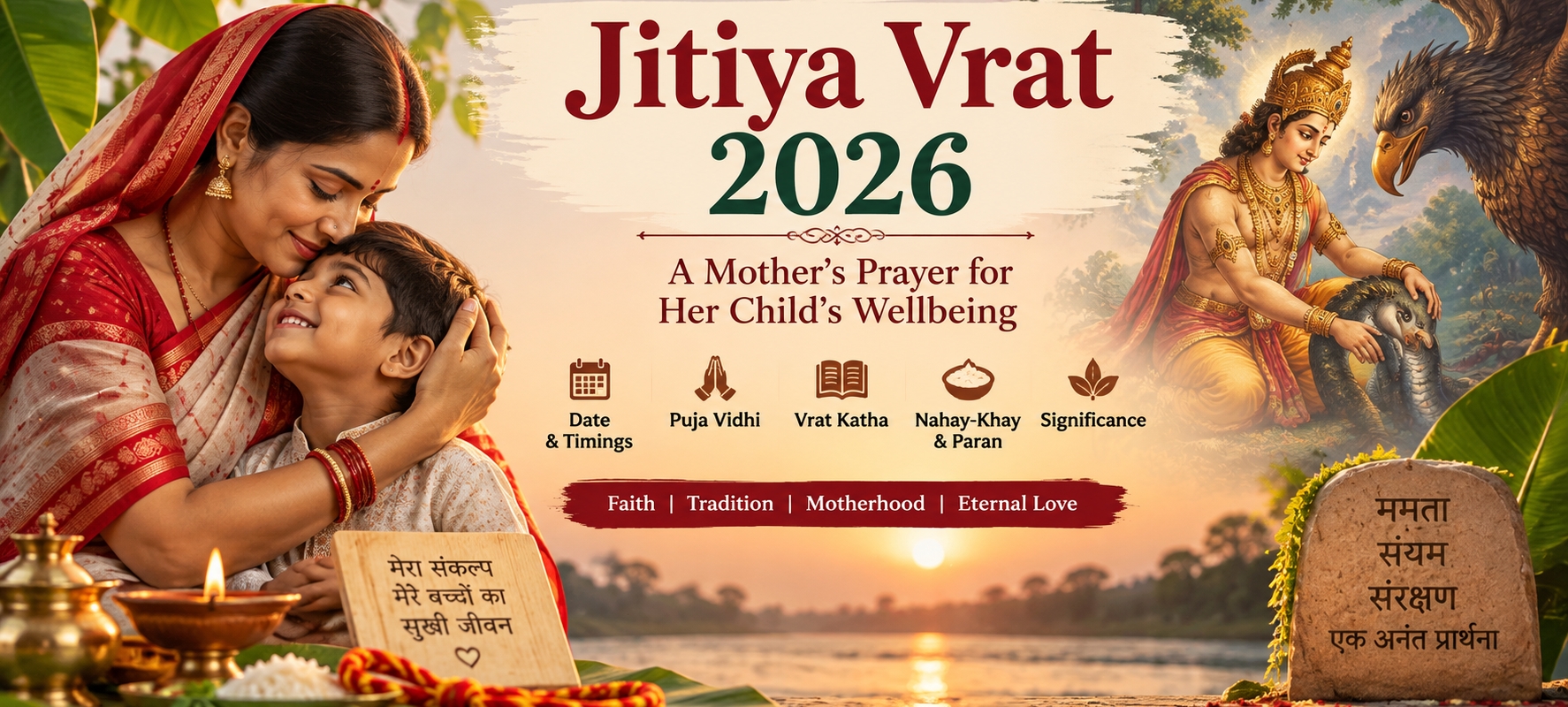
Jitiya Vrat 2026, also called Jivitputrika Vrat, is a traditional nirjala fast observed by mothers for the long life and wellbeing of their children. Discover the 2026 date, Nahay-Khay, Paran, vrat katha, puja vidhi and spiritual significance.
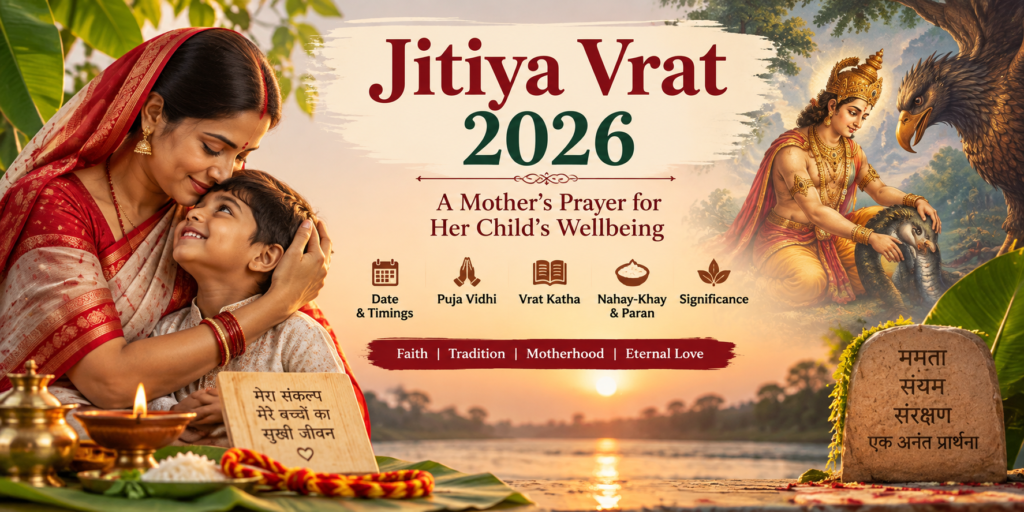
jitiya-vrat-2026-date-katha-puja-vidhi.jpg
Jitiya Vrat, also known as Jivitputrika Vrat, Jiutiya or Jiwitputra Vrat, is one of the most deeply emotional fasting traditions observed by mothers for the long life, health, safety and wellbeing of their children.
Unlike many festivals that are celebrated with elaborate feasts and festivities, Jitiya is marked by extraordinary restraint. The main vrat is traditionally observed as a nirjala fast, meaning that devotees abstain from both food and water for the prescribed period.
The festival is particularly associated with Bihar, Jharkhand, eastern Uttar Pradesh and the Terai region of Nepal. The Government of India’s Ministry of Tourism also describes Jivitputrika as a three-day observance involving Nahay-Khay, the main fast and the concluding ritual of breaking the fast.
But Jitiya is about much more than fasting.
At its heart lies a beautiful idea: a mother’s prayer, sacrifice and determination for the protection and wellbeing of her child.
In 2026, the festival also comes with an interesting Panchang question because different regional calendars place the main observance on different dates. Here is everything you need to know.
Jitiya Vrat 2026: When Is Jivitputrika Vrat?
According to several widely used Indian Panchang calculations, Jivitputrika Vrat 2026 falls on Saturday, 3 October 2026, corresponding to Ashwin Krishna Paksha Ashtami.
For New Delhi and several other Indian locations, the Ashtami tithi begins at approximately 7:59–8:00 AM on 3 October and ends at approximately 5:51–5:53 AM on 4 October. Drik Panchang lists the Jivitputrika fast on 3 October 2026.
However, there is an important regional variation.
The Government of Bihar’s 2026 holiday notification lists Jivitputrika Vrat on Sunday, 4 October 2026.
This difference is connected with regional Panchang traditions and the way the Ashtami tithi is applied to the fasting day.
Jitiya 2026 at a glance
| Ritual | 2026 Date* |
|---|---|
| Nahay-Khay | 2 October 2026 |
| Main Jitiya / Jivitputrika Vrat | 3 October 2026 in many Indian Panchang calculations |
| Ashtami Tithi | Approximately 3 October morning to 4 October early morning |
| Paran | 4 October 2026 |
| Bihar Government-listed observance | 4 October 2026 |
*Exact observance can vary according to the local Panchang and regional tradition. Families in Bihar and Mithila should follow their local Panchang or family tradition, particularly for the fasting date and Paran.
This distinction is worth mentioning because simply stating “Jitiya is on 3 October” without explaining the regional variation could confuse readers in Bihar.
What Is Jitiya Vrat?
Jitiya is the popular name for Jivitputrika Vrat.
The word Jivitputrika is traditionally associated with the wellbeing and continued life of one’s child. The vrat is observed primarily by mothers who pray for the long life, good health, protection and prosperity of their children.
The fast is traditionally especially associated with sons in some older descriptions, but contemporary observance is widely understood as a mother’s prayer for the wellbeing of her children.
The Ministry of Tourism describes Jivitputrika as a fast primarily observed in Bihar, Jharkhand and Uttar Pradesh, with the tradition also popular in Nepal.
In Bihar and Jharkhand, you may hear several names for the same observance:
- Jitiya
- Jiutiya
- Jiwit Putra
- Jivitputrika
- Jivitputrika Vrat
Despite differences in pronunciation and regional customs, the central sentiment remains the same: a mother’s devotion and prayer for her child’s wellbeing.
Why Is Jitiya Vrat So Important?
Jitiya carries a very different emotional character from many other Hindu vrats.
It is not simply a ritual of abstinence. It represents mamta, sacrifice, protection and faith.
A mother willingly accepts physical discomfort as an expression of her prayer for her child. The difficult nature of the nirjala fast has therefore become an important part of its spiritual symbolism.
The Government of Bihar’s cultural material notes that Jivitputrika is traditionally observed by mothers for the wellbeing of their children and that community worship, bhajans and narration of the Jivitputrika Vrat Katha form part of the observance.
For many families, Jitiya is also a time when:
- mothers gather together for worship,
- older women pass traditions to younger generations,
- vrat katha is recited,
- folk songs are sung,
- family members prepare traditional foods,
- and children become part of a living cultural tradition.
That is perhaps why Jitiya remains deeply rooted in the cultural memory of eastern India.
The Three Days of Jitiya Vrat
Although people often refer to Jitiya as a single fasting day, the observance traditionally unfolds over three stages.
1. Nahay-Khay
The first day is known as Nahay-Khay.
It is a day of purification and preparation.
Devotees traditionally take a bath, often giving special importance to bathing in a sacred river, pond or other water body where possible.
After purification, a simple sattvic meal is consumed.
The Ministry of Tourism describes the first day as Nahay-Khay and notes that traditional foods vary by region.
The idea is simple: before undertaking the demanding fast, the body and mind are prepared.
In many families, this day also has an atmosphere of quiet anticipation.
2. The Main Nirjala Jitiya Vrat
The second stage is the heart of the festival.
Mothers traditionally observe a nirjala vrat, abstaining from both food and water.
For many devotees, this is the most difficult part of Jitiya.
The fast is not merely seen as a physical discipline. It is an expression of determination and prayer.
The devotee keeps the fast with the intention that her child may remain:
- healthy,
- protected,
- prosperous,
- safe from misfortune,
- and blessed with a long life.
The exact beginning and ending of the fast should be determined according to the local Panchang because the timing of lunar tithis varies by location.
3. Paran — Breaking the Fast
The third stage is Paran, when the fast is formally broken.
In 2026, the Paran falls on the morning of 4 October under the commonly followed Indian calculation in which the main fast is on 3 October.
The exact Paran time depends on the location and the tradition being followed.
For New Delhi, current Panchang references place the end of Ashtami at approximately 5:51–5:53 AM on 4 October, while some sources give a later practical Paran time after the morning rituals.
Therefore, readers should not use a generic Paran time copied from another city.
Important:
Jitiya Paran is location-sensitive.
The sunrise, tithi ending time and local Panchang calculation can change the practical timing.
For a blog intended for a nationwide audience, it is better to advise readers to check the Panchang for their own city.
Jitiya Vrat 2026: The Important Tithi
Jivitputrika Vrat is observed on Ashwin Krishna Paksha Ashtami according to the Purnimanta lunar calendar.
For several Indian locations in 2026:
Ashtami begins: approximately 7:59–8:00 AM, October 3
Ashtami ends: approximately 5:51–5:53 AM, October 4
Drik Panchang’s 2026 calculations show these timings for different Indian locations, with slight local variations.
This is also the reason readers may see both October 3 and October 4 mentioned online.
Why Do Some Sources Say Jitiya Is on October 3 and Others October 4?
This is one of the most important questions about Jitiya Vrat 2026.
The answer lies in the Hindu lunar calendar.
Hindu festivals are generally determined by tithi, not simply by the Gregorian calendar date.
A tithi can begin on one civil date and continue into the next. Different regional traditions may then apply different rules for determining the actual fasting day.
In 2026, the Ashtami tithi extends from the morning of October 3 into the early morning of October 4 in several Indian locations.
At the same time, the Bihar Government’s official holiday calendar lists Jivitputrika Vrat on October 4, 2026.
Therefore, a responsible 2026 article should acknowledge both dates rather than pretending there is no variation.
For readers:
If you live in Bihar, Mithila or another region with a specific family/community Panchang tradition, follow that tradition.
If you live elsewhere, check the Panchang calculated specifically for your city.
The Beautiful Story Behind Jitiya Vrat
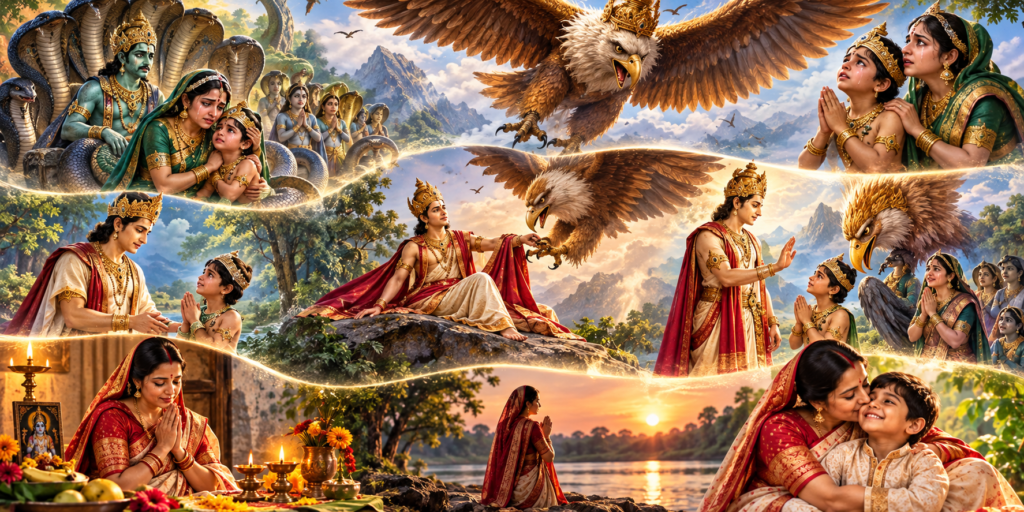
jitiya-vrat-story-jimutavahana-garuda-shankhachuda.jpg
The most famous legend associated with Jivitputrika Vrat is the story of King Jimutavahana, Garuda and the Naga prince Shankhachuda.
Traditional sources associate the Jivitputrika Vrat Katha with the Bhavishya Purana and Skanda Purana traditions.
The story begins with a young Naga named Shankhachuda, who is destined to become a victim of Garuda.
According to the traditional narrative, Garuda had been receiving Nagas as food under an arrangement made with the Naga king. Eventually, Shankhachuda’s turn arrives.
His mother is devastated.
Her grief reaches King Jimutavahana, a compassionate and selfless prince.
When Jimutavahana learns that Shankhachuda is destined to die, he decides to sacrifice himself in the young Naga’s place.
He covers himself with the cloth associated with the sacrificial offering and presents himself before Garuda.
Garuda attacks him, believing him to be the Naga who has been sent as food.
Yet Jimutavahana does not respond with hatred.
Instead, he remains committed to saving the young man.
When Garuda eventually realizes what has happened, he is deeply moved by Jimutavahana’s extraordinary selflessness.
The story culminates in the restoration of life and the ending of the terrible cycle of sacrifice.
Traditional versions of the story differ in their details, but the central message remains remarkably powerful:
A life offered for another life becomes an act of supreme compassion.
The Jivitputrika tradition therefore connects the mother’s fast with an older cultural ideal of protecting life through sacrifice and selflessness.
What Does Jimutavahana Have to Do With a Mother’s Vrat?
At first glance, the connection may seem indirect.
Jimutavahana was not a mother, nor was the original story simply about motherhood.
Its deeper connection is the willingness to accept suffering for the sake of another person’s life.
That is precisely the emotional idea that devotees associate with Jitiya.
A mother undertakes hardship for the wellbeing of her child.
Jimutavahana undertakes suffering to protect another life.
Both narratives place selfless protection above personal comfort.
That is what gives the festival a meaning that goes beyond ritual.
Jitiya Vrat Puja Vidhi: How Is It Observed?
Ritual details vary considerably by region and family tradition.
A general observance may include:
Step 1: Morning purification
The devotee wakes early, bathes and prepares herself for the day’s rituals.
Where customary, devotees may bathe at a sacred water body.
Step 2: Sankalp
A vrat sankalp is taken with the intention of praying for the wellbeing and long life of one’s children.
Step 3: Worship
The family performs the prescribed local worship associated with Jivitputrika.
Traditional sources also describe worship of Lord Vasudeva in connection with the vrat.
Step 4: Jivitputrika Vrat Katha
The vrat katha is recited or heard.
The story of Jimutavahana, Garuda and Shankhachuda is central to many traditions.
Step 5: Sacred thread
In some traditions, mothers wear a special Jitiya thread, often described as red and yellow.
The Government of Bihar’s cultural material also records the tradition of mothers wearing a red-and-yellow Jitiya thread.
Step 6: Nirjala fast
The main vrat is observed without food and water according to the devotee’s tradition.
Step 7: Paran
After the prescribed tithi and ritual conditions are fulfilled, the fast is broken the following morning.
Jitiya Vrat Puja Samagri List
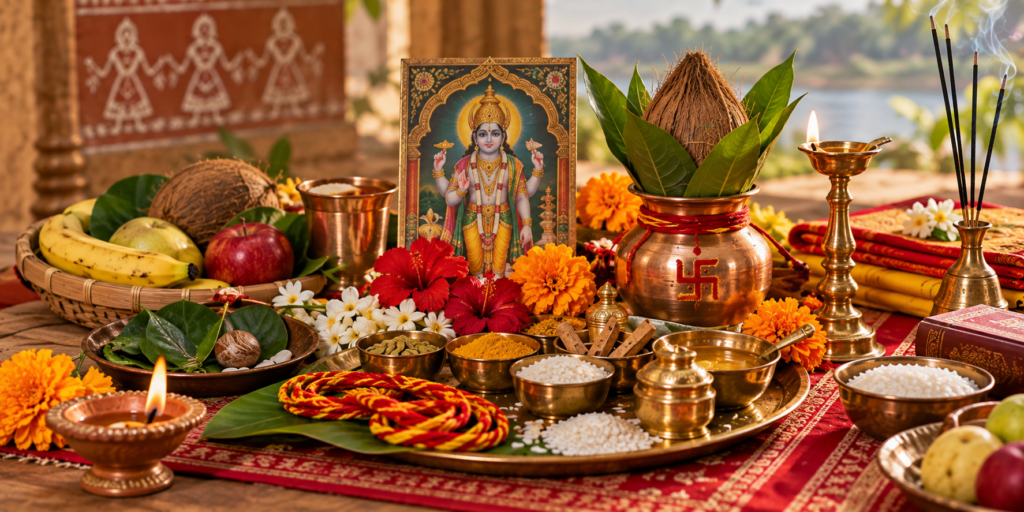
jitiya-vrat-puja-samagri-list.jpg
The exact samagri differs from one region to another, but a traditional preparation may include:
- Jitiya vrat thread
- Roli
- Kumkum
- Akshat
- Turmeric
- Sandalwood
- Flowers
- Durva
- Incense
- Diya
- Ghee
- Cotton wicks
- Fruits
- Seasonal vegetables
- Cucumber
- Rice or rice flour
- Traditional vrat foods
- Water for puja
- Kalash
- Betel leaves
- Supari
- Dakshina
- Prasad ingredients
It is important to remember that there is no single universal Jitiya samagri list. Local customs can differ significantly.
Traditional Foods Associated With Jitiya
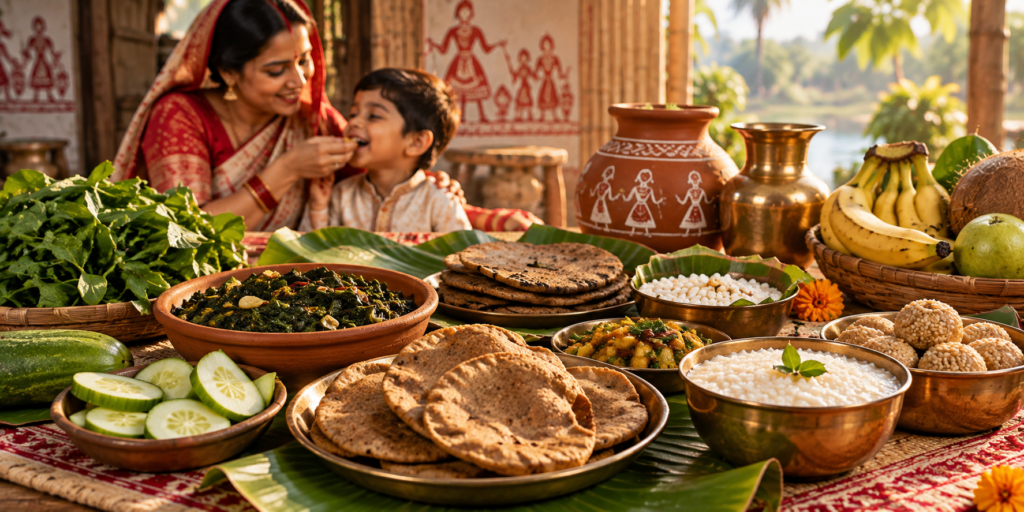
traditional-foods-jitiya-vrat.jpg
Jitiya is a fasting festival, but food becomes particularly important during Nahay-Khay and Paran.
The Ministry of Tourism notes that in some places the fast is broken with foods such as rice-flour porridge and cucumber, while other regional foods can include noni saag and madua roti.
The Paran meal therefore becomes more than just food.
It marks the transition from austerity back to everyday life.
Different communities prepare different dishes, and family recipes are often passed down from mothers and grandmothers.
This is one of the quieter but beautiful aspects of Jitiya: food becomes part of cultural memory.
Jitiya Vrat and the Mother-Child Bond
jitiya-vrat-mother-child-bond.jpg
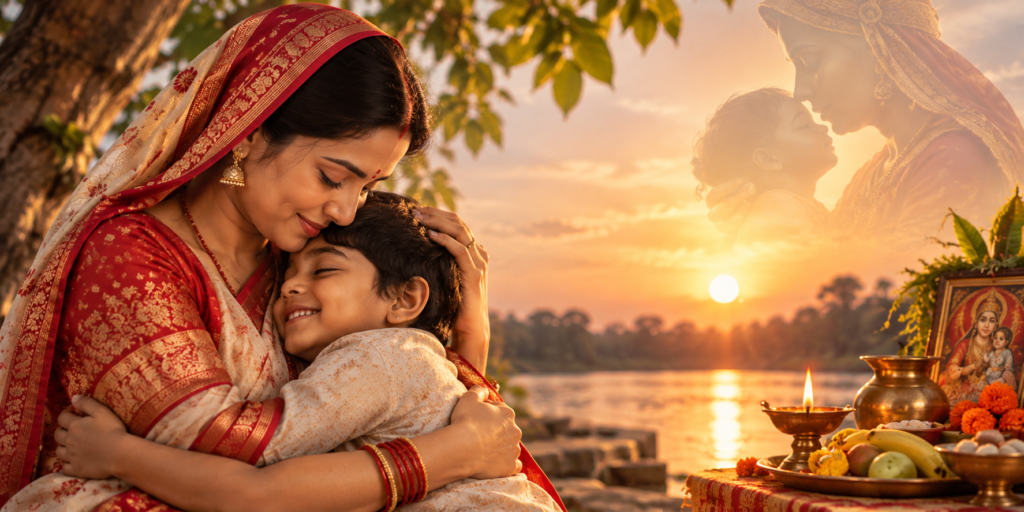
Perhaps the most moving aspect of Jitiya is that its spirituality is deeply personal.
There are no grand temples required.
No elaborate pilgrimage is necessary.
At the centre of the vrat is simply a mother sitting with a prayer in her heart.
She may pray for:
“May my child remain healthy.”
“May my child be protected.”
“May my child have a long and meaningful life.”
“May no sorrow touch my child.”
That makes Jitiya deeply relatable even to people who have never personally observed the fast.
The ritual is an expression of something universal:
the desire of a parent to protect their child.
Jitiya Vrat in Bihar, Jharkhand and Uttar Pradesh
Jitiya is especially prominent in eastern and northern India.
It has a strong cultural presence in:
- Bihar
- Jharkhand
- Eastern Uttar Pradesh
- parts of Madhya Pradesh and Chhattisgarh
- Nepal’s Terai region
The Government of India’s Ministry of Tourism specifically identifies Bihar, Jharkhand and Uttar Pradesh as major areas of observance and also notes its popularity in Nepal.
The festival can look quite different from one region to another.
The food may change.
The songs may change.
The precise ritual sequence may change.
Even the date can differ according to regional Panchang practice.
Yet the central prayer remains remarkably consistent.
Jitiya Vrat in Nepal
The festival is also deeply significant in Nepal, particularly in the Terai and Madhesh regions.
There it is commonly known as Jitiya Parva.
The same central themes of maternal devotion, fasting and children’s wellbeing are present, while local traditions add their own cultural flavour.
Nepal-focused traditional sources also preserve the Jivitputrika Katha involving Garuda, the Nagas and Shankhachuda.
The date can differ between Indian and Nepali calendars because the local sunrise and tithi calculations are location-dependent.
Therefore, Nepali readers should follow their local calendar rather than automatically copying an Indian city-specific date.
Is Jitiya Vrat Only for Mothers?
Traditionally, Jivitputrika is strongly identified with mothers observing the vrat for their children.
However, Hindu fasting traditions have always contained considerable regional and family variation.
The central purpose of Jitiya is the wellbeing of children, and the exact participation and ritual practices can vary.
For this reason, it is better to describe Jitiya as a traditional maternal vrat for children’s wellbeing rather than imposing one identical ritual practice on every community.
Is Jitiya Vrat Nirjala?
Traditionally, yes.
The main Jivitputrika fast is widely described as a nirjala vrat, meaning devotees abstain from both food and water.
The Ministry of Tourism describes mothers observing the fast without water for the main fasting period.
However, a nirjala fast is physically demanding.
People with medical conditions, those taking regular medicines, pregnant or breastfeeding women, older adults and anyone for whom prolonged fasting may be unsafe should not assume that they must follow the strictest form of the fast.
Religious observance should not come at the expense of health.
If necessary, a person can follow the guidance of their doctor and family religious tradition.
Jitiya Vrat vs Chhath Puja: What Is the Difference?
Jitiya and Chhath are both especially important in Bihar and neighbouring regions, but they are different festivals.
| Jitiya Vrat | Chhath Puja |
|---|---|
| Associated with Jivitputrika | Dedicated primarily to Surya and Chhathi Maiya |
| Traditionally observed by mothers for children | Observed by devotees for family wellbeing and other prayers |
| Main fast occurs on Ashwin Krishna Ashtami | Chhath occurs in Kartik and also Chaiti Chhath |
| Known for nirjala fasting | Known for offerings to the Sun at sunrise and sunset |
| Jimutavahana is central to its traditional katha | Sun worship is central |
| Especially prominent in Bihar, Jharkhand, eastern UP and Nepal | Particularly prominent in Bihar, Jharkhand, eastern UP and Nepal |
The festivals share a strong cultural connection with eastern India, but their mythology and ritual structures are distinct.
Spiritual Meaning of Jitiya Vrat
Beyond the calendar dates and ritual rules, Jitiya carries several deeper ideas.
1. Sacrifice
The fast represents willingness to endure hardship for someone loved.
2. Protection
The prayer is directed toward the safety and wellbeing of children.
3. Compassion
The story of Jimutavahana reminds devotees that true strength can be expressed through compassion rather than power.
4. Faith
A difficult fast requires determination and spiritual discipline.
5. Family tradition
Jitiya allows generations of women to pass songs, stories, recipes and rituals to one another.
6. Hope
At its simplest, the vrat is a prayer for tomorrow.
A mother fasts today because she hopes her child will have a healthier, safer and happier tomorrow.
Jitiya Vrat 2026: A Simple Timeline
Friday, 2 October 2026
Nahay-Khay
Purification, preparation and traditional meal.
Saturday, 3 October 2026
Main Jitiya Vrat
In many Panchang calculations, the main nirjala fast falls on this date.
Sunday, 4 October 2026
Paran
The fast is concluded after the prescribed tithi and local ritual requirements.
Important: Bihar’s official 2026 holiday notification lists Jivitputrika Vrat on 4 October, demonstrating why regional calendars should be checked before finalising the observance date.
Frequently Asked Questions About Jitiya Vrat 2026
When is Jitiya Vrat in 2026?
Many Indian Panchang calculations place Jitiya/Jivitputrika Vrat on Saturday, 3 October 2026, with Paran on 4 October. However, the Bihar Government’s 2026 holiday calendar lists Jivitputrika Vrat on 4 October 2026. Local and regional Panchang traditions should therefore be followed.
When is Nahay-Khay in Jitiya 2026?
Under the commonly followed three-day sequence, Nahay-Khay is observed on 2 October 2026.
When is Jitiya Paran in 2026?
The Paran is on 4 October 2026, after the relevant tithi and according to the local Panchang.
What is Jitiya Vrat?
Jitiya, or Jivitputrika Vrat, is a traditional Hindu fast observed mainly by mothers praying for the long life, health and wellbeing of their children.
Is Jitiya a nirjala vrat?
Traditionally, the main Jitiya fast is observed as a nirjala vrat, without food or water.
Who is worshipped during Jitiya?
Jitiya does not have one universally prescribed deity in all regional traditions. Traditional sources associate the vrat with Jimutavahana, while some ritual descriptions include worship of Lord Vasudeva.
What is the story of Jitiya Vrat?
The principal vrat katha tells the story of King Jimutavahana, who offers himself to Garuda in order to save the Naga prince Shankhachuda. The story represents compassion, sacrifice and protection.
Why is Jitiya important in Bihar?
Jitiya has deep roots in Bihar’s religious and cultural traditions and is observed through fasting, community worship, folk songs and recitation of the vrat katha.
Is Jitiya celebrated in Nepal?
Yes. Jivitputrika is widely observed in Nepal, particularly in the Terai region, where it is commonly known as Jitiya Parva.
Final Thoughts: The Prayer Behind the Fast
Jitiya Vrat is sometimes described simply as a difficult fast.
But that description misses its deepest meaning.
The real story of Jitiya is not hunger.
It is love.
It is the love of a mother who willingly embraces hardship while praying for the wellbeing of her child.
It is the story of Jimutavahana, who teaches that protecting another life can be greater than protecting one’s own comfort.
It is the memory of grandmothers teaching daughters the vrat katha.
It is the sound of traditional songs carried from one generation to another.
And it is the quiet moment after the fast, when a mother finally breaks her vrat and returns to ordinary life—with the same prayer she carried throughout the day:
“May my child always remain safe, healthy and blessed.”
That is what makes Jitiya more than a fasting ritual.
It is a celebration of maternal love, sacrifice, faith and hope.
And perhaps that is why, year after year, this ancient tradition continues to live in homes across Bihar, Jharkhand, eastern Uttar Pradesh and Nepal.
A Note on the 2026 Date
Because Jitiya 2026 falls during a tithi that crosses two civil dates, regional calendars differ. Current Panchang calculations commonly show the main fast on 3 October, while the Bihar Government’s official holiday notification lists 4 October. Readers should follow the Panchang traditionally used in their family and region and confirm the local Paran timing before beginning the vrat.
dharmicstories.com/jitiya-vrat-2026-date-time-katha-puja-vidhi
If this story moved you, share it.
Explore more in Festival →