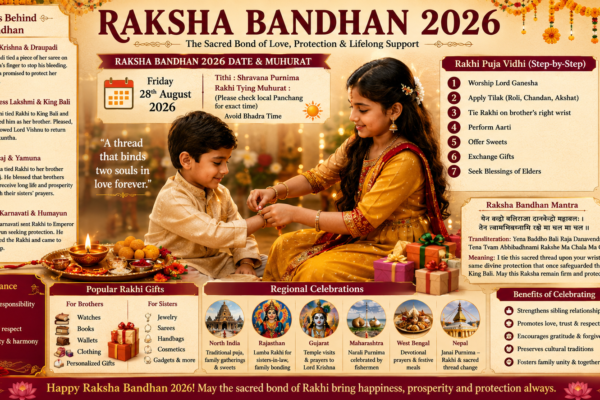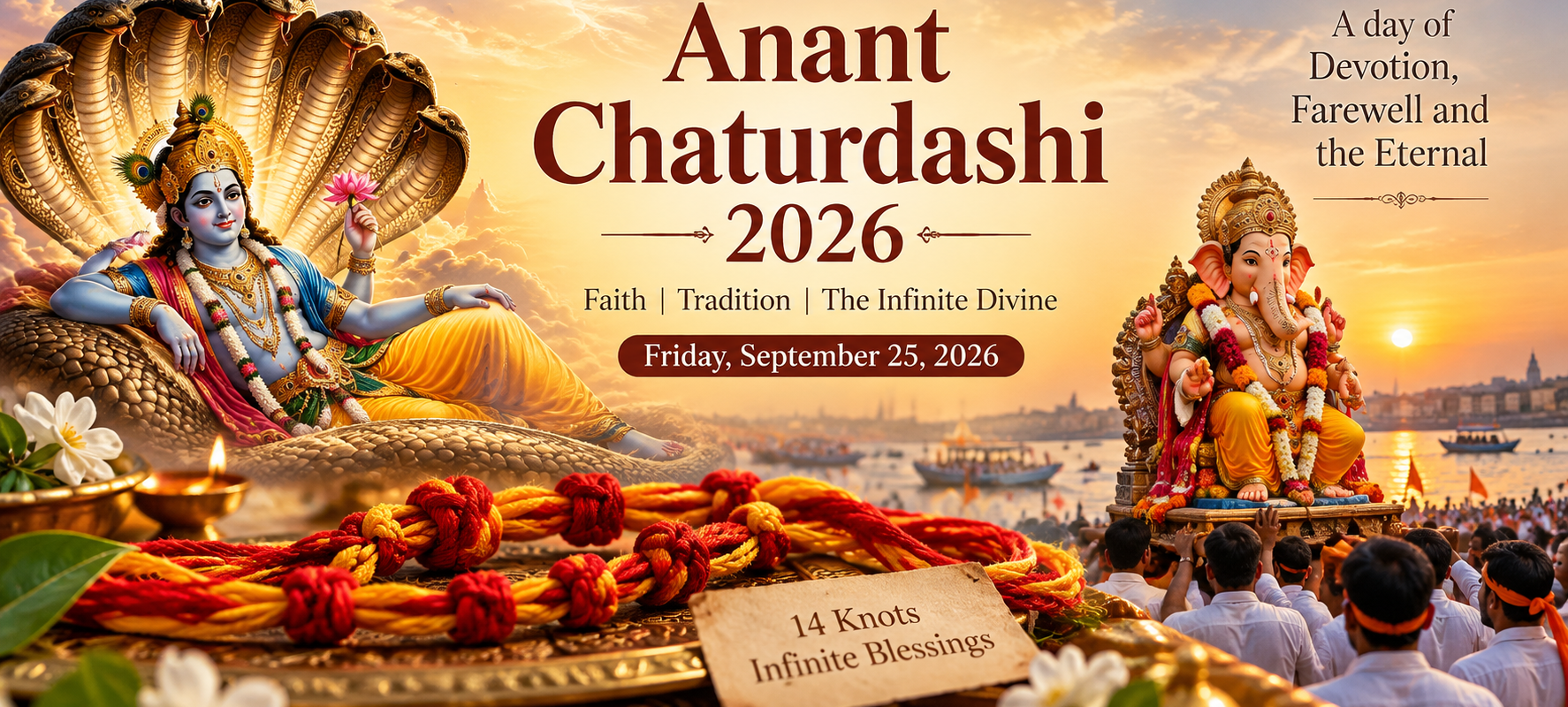
Anant Chaturdashi 2026 falls on September 25. Discover its date, tithi, puja vidhi, Anant Sutra, the story of Sushila and Kaundinya, the meaning of 14 knots, fasting traditions, and its connection with Ganesh Visarjan.
anant-chaturdashi-2026-date-puja-vidhi-ganesh-visarjan.jpg
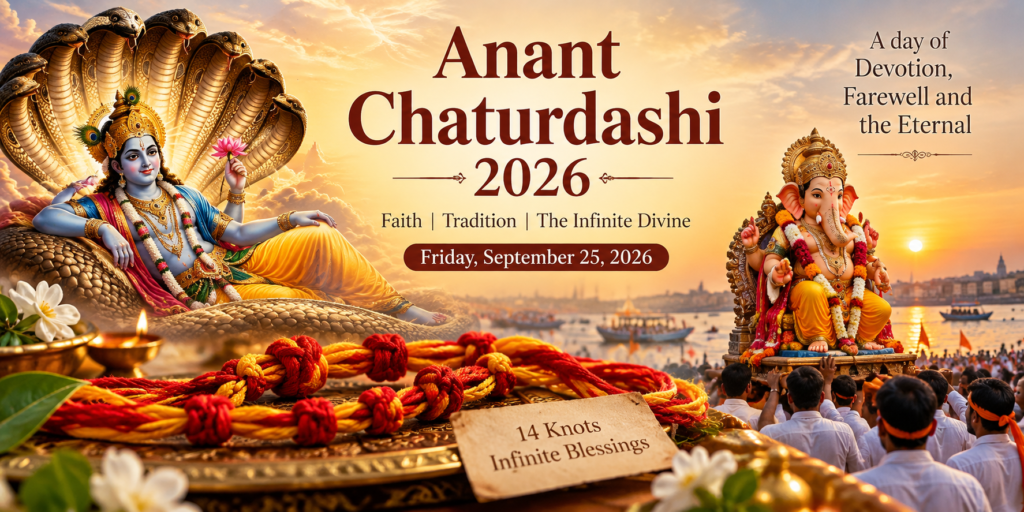
Anant Chaturdashi 2026 will be observed on Friday, September 25, 2026. Falling on the Chaturdashi, or fourteenth lunar day, of the bright fortnight of Bhadrapada, this sacred Hindu observance is dedicated to Lord Vishnu in his Ananta form—the Infinite, the One without beginning or end.
For millions of devotees, however, Anant Chaturdashi carries a second, equally visible identity. It is also the day when the grand Ganeshotsav traditionally reaches its conclusion, and many devotees bid farewell to Lord Ganesha through Ganesh Visarjan.
That connection often causes the deeper meaning of the festival to be overlooked.
At its heart, Anant Chaturdashi is about Ananta—the infinite presence of the Divine, the sacred promise of faith, and the thread of continuity that connects human life with something greater than itself.
One of the most beautiful rituals of the day is the tying of the Anant Sutra, a sacred thread traditionally prepared with 14 knots. These knots are associated in tradition with the 14 worlds, or lokas, and the thread itself becomes a visible reminder of devotion, discipline and one’s spiritual resolve.
So, what exactly is Anant Chaturdashi? Why are there 14 knots in the Anant Sutra? What is the story of Sushila and Kaundinya? How is the puja performed? And how is this Vishnu vrata connected with the farewell to Lord Ganesha?
Let us explore the festival from both its ritual and spiritual perspective.
Anant Chaturdashi 2026: Date and Tithi
In 2026, Anant Chaturdashi falls on Friday, September 25.
The day corresponds to Bhadrapada Shukla Chaturdashi, the fourteenth tithi of the waxing Moon in the month of Bhadrapada.
For the Delhi-NCR region, Panchang calculations place the Chaturdashi tithi from approximately 11:18 PM on September 24 until around 11:06–11:08 PM on September 25.
Because the Chaturdashi tithi is present during the daytime of September 25, Anant Chaturdashi is observed on September 25, 2026.
Anant Chaturdashi 2026 — Quick Details
| Detail | Information |
|---|---|
| Festival | Anant Chaturdashi |
| Date | Friday, September 25, 2026 |
| Hindu Month | Bhadrapada |
| Paksha | Shukla Paksha |
| Tithi | Chaturdashi |
| Primary Deity | Lord Vishnu as Ananta |
| Sacred Thread | Anant Sutra |
| Number of Knots | 14 |
| Major Associated Festival | Ganesh Visarjan |
| Also Known As | Anant Chaudas / Ananta Chaturdashi |
Note: Panchang timings are location-sensitive. If you are performing the puja, use the Panchang for your own city rather than relying blindly on timings from another city.
What Is Anant Chaturdashi?
what-is-anant-chaturdashi-vishnu-ananta.jpg
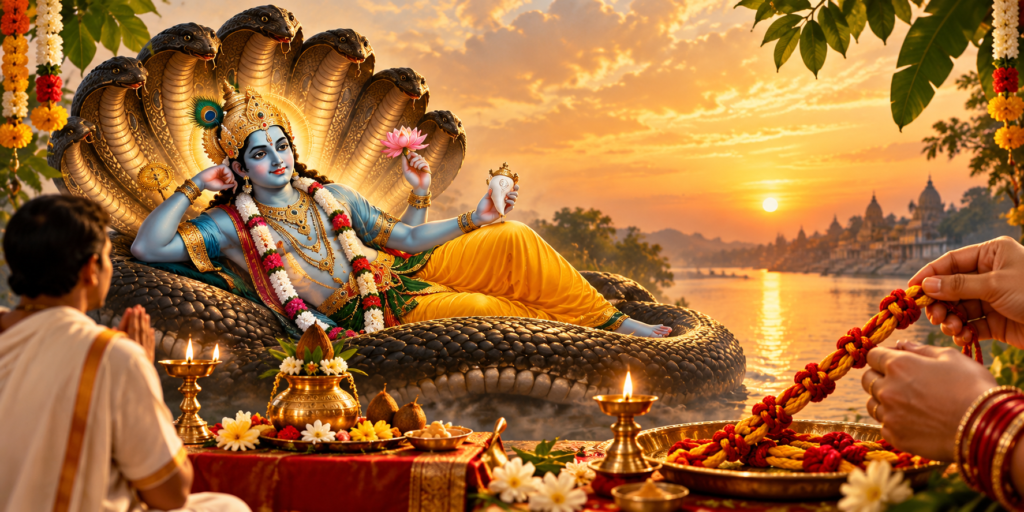
The word Ananta means endless, infinite or without limit, while Chaturdashi refers to the fourteenth lunar day.
Anant Chaturdashi is therefore the sacred fourteenth day associated with Ananta, the infinite form of Lord Vishnu.
In Hindu tradition, Ananta is closely associated with Shesha or Ananta Shesha, the cosmic serpent upon whom Lord Vishnu is traditionally depicted reclining in the Kshira Sagara, the cosmic ocean of milk.
The festival is observed as an Ananta Vrata, a religious vow dedicated to Lord Ananta.
The central ritual involves worshipping Ananta and wearing a sacred thread containing fourteen knots. Traditional texts describe variations in the ritual, including worship of Ananta represented through sacred grass or a symbolic form, offerings of food, prayer and the wearing of the consecrated thread.
The vrata is traditionally associated with wishes for well-being, stability, prosperity and protection, although the precise practices and beliefs vary between communities and regions.
Why Is Anant Chaturdashi Celebrated?
Anant Chaturdashi is celebrated primarily to honor Lord Vishnu as Ananta, the infinite and eternal Divine presence.
The vrata is also understood as a spiritual commitment.
The Anant Sutra is not simply a decorative thread. Once worshipped and tied, it represents a devotee’s connection with Ananta and serves as a reminder of the vow undertaken.
Traditional accounts associate the observance with:
- devotion to Lord Vishnu
- protection and well-being
- stability in family life
- prosperity
- fulfillment of righteous wishes
- perseverance during difficult periods
- remembrance of the eternal nature of the Divine
The emphasis, however, is not merely on receiving something from God.
There is a deeper message hidden in the word Ananta.
Human circumstances change. Wealth comes and goes. Relationships pass through different phases. Success and failure alternate.
But the idea of Ananta points toward something that does not change with these temporary circumstances.
The festival therefore invites devotees to look beyond the temporary and remember the eternal.
The Beautiful Meaning of the Anant Sutra
Perhaps the most recognizable ritual of Anant Chaturdashi is the Anant Sutra.
It is generally a cotton or silk thread, traditionally dyed red, saffron or orange, and prepared with 14 knots.
After the thread has been worshipped, it is tied to the arm.
Traditionally:
- Men wear it on the right arm.
- Women wear it on the left arm.
However, regional customs can differ, so families may follow the practice passed down through their own tradition.
The thread is considered sacred because it has first been offered during the worship of Ananta.
Why Does the Anant Sutra Have 14 Knots?
anant-sutra-14-knots-fourteen-lokas.jpg
This is one of the most fascinating aspects of Anant Chaturdashi.
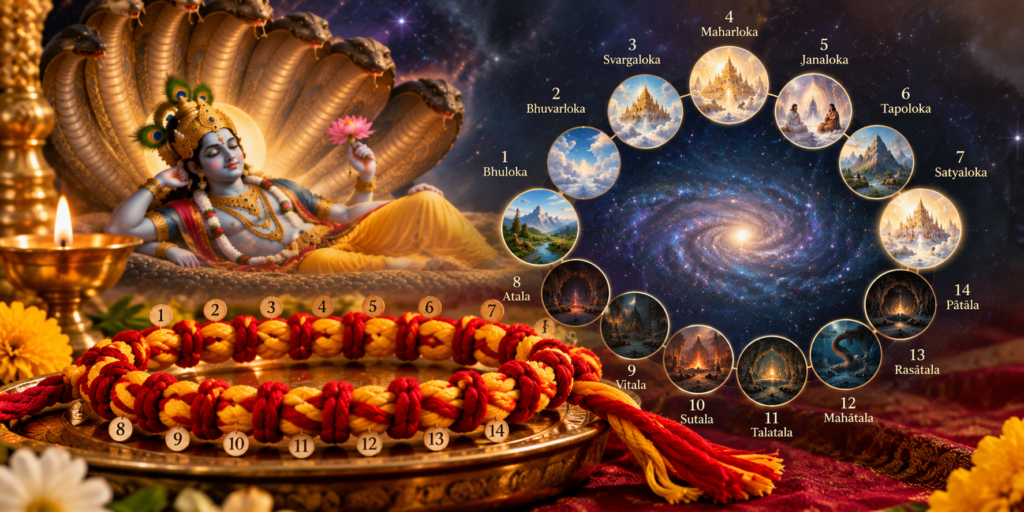
The 14 knots are traditionally connected with the 14 worlds, or lokas, of Hindu cosmology.
These are generally described as seven higher realms and seven lower realms.
The Seven Higher Lokas
- Bhuloka
- Bhuvarloka
- Svargaloka
- Maharloka
- Janaloka
- Tapoloka
- Satyaloka
The Seven Lower Lokas
- Atala
- Vitala
- Sutala
- Talatala
- Mahātala
- Rasātala
- Pātāla
Thus, the fourteen knots can be understood as a symbolic representation of the complete cosmic order described in Hindu tradition.
There is also a traditional association between the number fourteen and the period of the vrata in some accounts.
But there is an even more personal way to understand the thread.
Every time the devotee looks at those fourteen knots, the thread can become a reminder:
Faith requires continuity.
A promise made before God is not supposed to disappear when life becomes difficult.
Anant Chaturdashi Vrat Katha: The Story of Sushila and Kaundinya
The most popular story associated with Anant Chaturdashi is the story of Sushila and Kaundinya.
Different traditional texts and retellings contain variations in names, details and ritual descriptions, so the story is best understood as a traditional vrata-katha rather than a single uniform version.
According to the widely narrated version, there once lived a Brahmin named Sumantu, whose daughter was Sushila.
Sushila was married to the sage Kaundinya.
After her marriage, Sushila began her journey with her husband. During the journey, they stopped near a river.
While Kaundinya was occupied with his evening religious duties, Sushila noticed a group of women performing a sacred worship.
Curious, she approached them and asked what they were doing.
The women explained that they were observing the Ananta Vrata, dedicated to Lord Ananta.
They told Sushila about the significance of the vrata and the sacred thread with fourteen knots.
Sushila listened with faith.
She decided to undertake the observance and received the sacred Anant Sutra.
After completing the ritual, she returned to Kaundinya.
When Kaundinya saw the thread on her arm, he asked her about it.
Sushila explained the vrata and told him that the women had taught her about Ananta.
Kaundinya, however, did not accept the significance of the thread.
In some versions of the story, he became angry and removed the thread, throwing it into the fire.
Soon afterward, their prosperity began to disappear.
Their circumstances deteriorated, and Kaundinya eventually realized that his disrespect toward Ananta had been a serious mistake.
Filled with regret, he set out in search of Ananta.
He wandered through the forest, asking about the Divine presence he was seeking.
Eventually, after intense repentance and devotion, Ananta appeared to him.
Kaundinya understood his mistake and sought forgiveness.
Ananta instructed him to observe the vrata faithfully.
Kaundinya accepted the instruction and restored his connection with the sacred vow.
The story concludes with the restoration of prosperity and peace.
What Does the Anant Chaturdashi Story Teach Us?
The story is much more than a tale about losing and regaining wealth.
Its deeper lesson lies in humility.
Kaundinya’s mistake was not simply removing a thread.
He failed to understand the faith behind it.
The thread represented a sacred commitment, but he judged it only by its outward appearance.
That is an important spiritual idea.
A simple object can become meaningful when it carries faith, intention and remembrance.
The story also emphasizes another important quality:
Repentance is not weakness.
Kaundinya recognizes his mistake, seeks Ananta and accepts the discipline of the vrata.
In this sense, the story presents devotion not as perfection, but as the willingness to recognize one’s error and return to the right path.
Anant Chaturdashi Puja Vidhi 2026
The exact puja procedure varies between regions and family traditions. The following is a simple traditional framework that can be followed at home.
Step 1: Clean the Puja Space
Clean the place where the puja will be performed.
A small wooden chowki can be covered with a clean cloth.
Many families use red, yellow or saffron cloth for Vishnu-related worship.
Step 2: Prepare the Anant Sutra
Prepare a clean cotton or silk thread.
Traditionally, the thread is prepared with 14 knots and may be colored red, saffron or orange.
The thread should be placed before the deity during the puja so that it becomes part of the worship.
Step 3: Establish Lord Vishnu’s Presence
Place an image or murti of Lord Vishnu.
A representation of Ananta or Shesha can also be included.
Some traditional descriptions mention using darbha grass as a symbolic representation of Ananta.
A kalash filled with clean water may also be placed as part of the puja arrangement.
Step 4: Light the Diya
Light a ghee or oil diya.
Offer incense and flowers.
Take a moment to settle your mind before beginning the main worship.
Step 5: Offer the Traditional Puja Items
Offer items according to your family tradition, such as:
- flowers
- tulsi leaves
- sandalwood
- kumkum
- akshat
- incense
- diya
- fruits
- sweets
- water
- panchamrit
- naivedya
Tulsi is traditionally associated with Lord Vishnu and is commonly included in Vishnu worship.
Step 6: Worship the Anant Sutra
Place the fourteen-knotted thread before Lord Vishnu.
Offer flowers and akshat.
Pray sincerely for the well-being of your family and for the strength to remain truthful and devoted.
Step 7: Read or Listen to the Vrat Katha
Read the story of Sushila and Kaundinya.
Listening to the vrata-katha is an important part of many traditional observances.
Step 8: Tie the Anant Sutra
After the worship, the sacred thread is tied on the arm.
Traditionally:
Men — right arm
Women — left arm
If your family follows a different established custom, it is perfectly reasonable to follow that tradition.
Step 9: Perform Aarti
Complete the puja with Vishnu Aarti or a Vishnu prayer.
You may chant:
Om Namo Bhagavate Vasudevaya
or
Om Namo Narayanaya
with devotion.
Anant Chaturdashi Puja Samagri List
anant-chaturdashi-puja-samagri-list.jpg
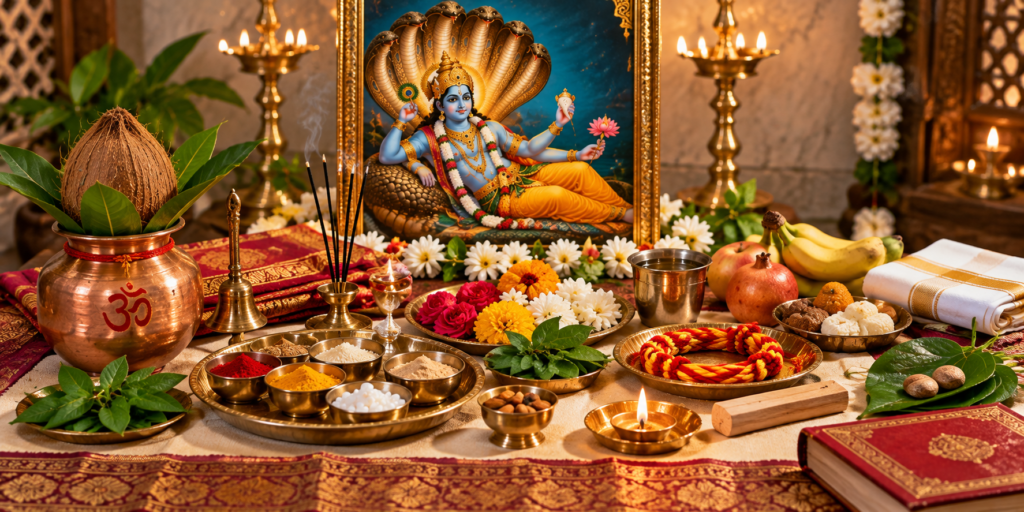
If you are preparing for Anant Chaturdashi at home, this simple checklist can help.
Basic Puja Items
- Lord Vishnu picture or murti
- clean puja cloth
- chowki
- kalash
- water
- mango leaves, if traditionally used
- diya
- ghee or oil
- cotton wicks
- incense
- sandalwood
- kumkum
- turmeric
- akshat
- flowers
- Tulsi leaves
- fruits
- sweets
- panchamrit ingredients
- betel leaves and सुपारी, if used in your family tradition
- dakshina
- clean cotton/silk thread
- materials for making 14 knots
Traditional Food Offerings
Different communities prepare different naivedya.
Traditional vrata descriptions mention preparations made from flour, ghee and sugar, while regional practices may include puri, pua, sweets, fruits and other vegetarian offerings.
There is no need to make the puja unnecessarily elaborate.
Devotion and sincerity are more important than extravagance.
Should You Keep a Fast on Anant Chaturdashi?
Yes, fasting is traditionally associated with the Ananta Vrata.
However, fasting practices differ considerably.
Some devotees observe a strict fast.
Others take fruits, milk or simple satvik food.
Traditional texts also contain variations regarding the number of meals and food restrictions.
Therefore, if you observe the vrata, follow the practice appropriate to your health, family tradition and religious custom.
Those who have medical conditions, take regular medication, are pregnant, elderly or otherwise should not fast strictly without appropriate medical guidance.
The spiritual purpose of the vrata is discipline and devotion, not physical suffering.
What Food Is Prepared on Anant Chaturdashi?
Food traditions vary by region.
Some traditional descriptions mention preparations using flour, ghee and sugar.
In parts of North India, devotees may prepare puri, pua, halwa, kheer and other satvik foods.
The exact menu is not universal.
The important principle is that the food offered during the vrata should be prepared cleanly and according to the family’s tradition.
After the puja, the naivedya is offered to the deity and then shared as prasad.
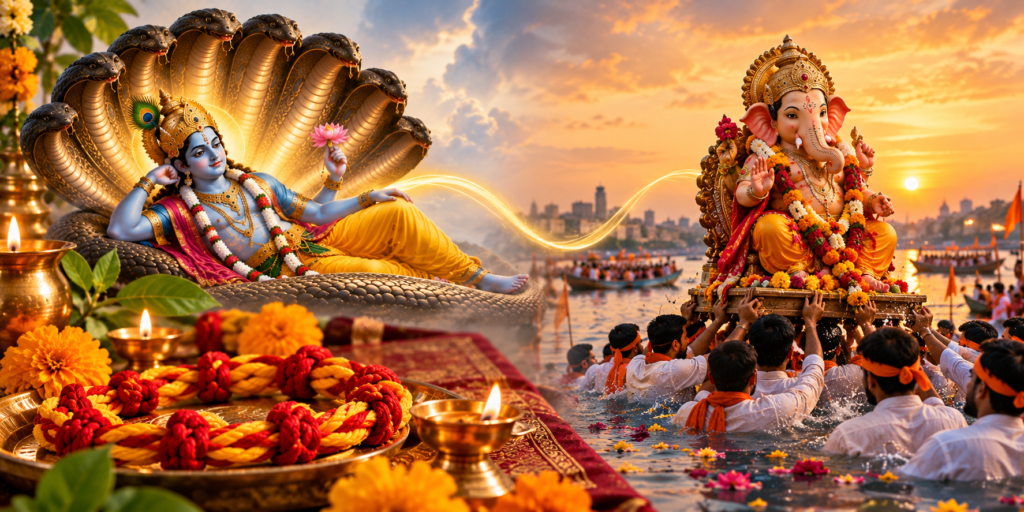
Anant Chaturdashi and Ganesh Visarjan: What Is the Connection?
anant-chaturdashi-ganesh-visarjan-connection.jpg
This is where Anant Chaturdashi becomes particularly interesting.
Today, many people immediately associate September’s Anant Chaturdashi with Ganesh Visarjan.
And rightly so.
In many parts of India, especially Maharashtra, the festival marks the culmination of the ten-day Ganeshotsav.
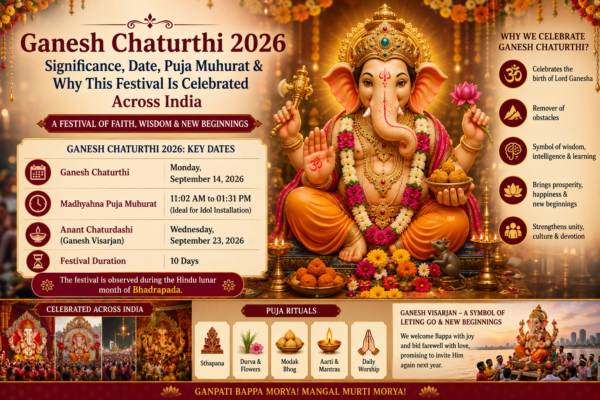
In 2026, Ganesh Chaturthi is observed on September 14, while the major tenth-day Ganesh Visarjan falls on Friday, September 25, Anant Chaturdashi.
On this day, devotees carry their Ganesha idols in processions accompanied by:
- devotional singing
- dhol and traditional music
- dancing
- prayers
- flower offerings
- chants of farewell
The idol is then immersed according to local customs.
The familiar chant:
“Ganpati Bappa Morya, Pudchya Varshi Lavkar Ya!”
expresses a beautiful sentiment:
Lord Ganesha is being bid farewell, but devotees already look forward to welcoming him again.
Anant Chaturdashi Is More Than Ganesh Visarjan
It is worth remembering that Anant Chaturdashi and Ganesh Visarjan are related in the modern festival calendar, but they are not the same religious observance.
Anant Chaturdashi is traditionally a Vishnu vrata.
Ganesh Visarjan is the concluding ritual associated with Ganeshotsav.
Both happen on the same date in 2026.
This gives September 25 a remarkable devotional character: one deity is lovingly welcomed back into the eternal cycle through immersion, while another form of the Divine—Ananta—is worshipped as the infinite and everlasting.
There is something profoundly beautiful about that coexistence.
Anant Chaturdashi 2026 Ganesh Visarjan Muhurat
Ganesh Visarjan does not have one universal time for all of India.
The auspicious Choghadiya windows vary according to location.
For example, for Noida, a Delhi-NCR reference, the 2026 Anant Chaturdashi Visarjan windows include:
- Morning: approximately 6:10 AM–10:42 AM
- Afternoon Shubh: approximately 12:12 PM–1:43 PM
- Afternoon Chara: approximately 4:43 PM–6:14 PM
- Night Labh: approximately 9:13 PM–10:43 PM
These are location-specific Panchang calculations, so devotees should check the local Panchang before planning immersion.
For large public celebrations, local administration and immersion-site instructions should also be followed.
Regional Traditions of Anant Chaturdashi
Anant Chaturdashi is observed differently across India.
Maharashtra
The day is strongly associated with the conclusion of the enormous Ganeshotsav celebrations.
The atmosphere can be both festive and emotional as devotees take Ganesha idols for immersion.
Bihar and Eastern Uttar Pradesh
The Ananta vrata tradition has a strong presence in several communities.
The ritual may include distinctive offerings and preparations associated with the fourteen knots and the symbolism of Ananta.
Nepal
Ananta Chaturdashi is also observed in Nepal, with local traditions connected with Vishnu and the sacred Ananta thread.
Vaishnava Traditions
Vaishnava communities may place greater emphasis on Anantadeva/Ananta Shesha and Lord Vishnu, prayer and devotional chanting.
ISKCON Delhi, for example, observes Ananta Caturdasi Vrata as a day connected with Lord Anantadeva and also commemorates the disappearance day of Srila Haridasa Thakura.
These differences are not contradictions.
They demonstrate how one sacred observance can develop rich regional expressions while retaining its central connection with Ananta.
The Spiritual Symbolism of Anant Chaturdashi
There are several layers of meaning hidden within this festival.
1. Ananta Means Infinity
Everything around us changes.
But the Divine, represented here as Ananta, is described as limitless and eternal.
The festival therefore turns our attention from the temporary toward the infinite.
2. The Thread Represents Commitment
The Anant Sutra is worn after worship.
It becomes a physical reminder of an invisible promise.
Every time the devotee sees it, the thread can remind them of the vrata.
3. Fourteen Knots Represent Cosmic Completeness
The fourteen knots are traditionally associated with the fourteen lokas.
The small thread therefore carries an enormous cosmological idea.
4. The Story Teaches Humility
Kaundinya’s story reminds devotees not to dismiss something simply because its external appearance seems ordinary.
5. The Festival Teaches Continuity
Anant Chaturdashi comes at a time when another beloved festival—Ganeshotsav—is coming to an end.
Ganesha’s immersion teaches that physical forms may return to the elements.
Ananta reminds devotees of the eternal.
Together, the two traditions create a powerful reflection on arrival, departure and continuity.
Anant Chaturdashi Puja Mantra
Devotees may chant simple Vishnu mantras during the worship.
Om Namo Bhagavate Vasudevaya
ॐ नमो भगवते वासुदेवाय
Meaning:
I bow to Lord Vasudeva, the Divine Lord.
Another simple mantra is:
Om Namo Narayanaya
ॐ नमो नारायणाय
Those following a particular family or sampradaya tradition may use the mantra prescribed by their guru or family tradition.
What Should You Do on Anant Chaturdashi?
If you want to observe the festival simply at home, you do not need an elaborate arrangement.
You can:
- Wake up and bathe early.
- Wear clean clothes.
- Clean your puja area.
- Place Lord Vishnu’s image or murti.
- Prepare the 14-knotted Anant Sutra.
- Offer flowers and Tulsi.
- Light a diya.
- Perform Vishnu puja.
- Listen to or read the Anant Vrat Katha.
- Tie the sacred thread according to your tradition.
- Chant Vishnu mantras.
- Offer naivedya.
- Perform aarti.
- Share the prasad with family.
- If participating in Ganesh Visarjan, follow local environmental and immersion guidelines.
What Should Be Avoided on Anant Chaturdashi?
Religious customs differ, but devotees traditionally try to keep the day peaceful and disciplined.
You may choose to avoid:
- unnecessary arguments
- harsh speech
- disrespect toward others
- excessive consumption
- non-satvik food if following a vrat
- wasteful celebrations
- disrespect toward sacred objects
The purpose of a vrata is not merely to complete a checklist.
It is to create a little more discipline, awareness and devotion in everyday life.
Eco-Friendly Ganesh Visarjan in 2026
As Ganesh Visarjan takes place on a large scale, environmental responsibility becomes especially important.
If you are immersing a Ganesha idol, consider:
- choosing a natural clay idol
- avoiding toxic paints
- using designated artificial immersion tanks where available
- following local municipal guidelines
- avoiding plastic decorations near water bodies
- disposing of flowers and puja material responsibly
The farewell to Ganesha should be conducted with the same respect with which the deity was welcomed.
Frequently Asked Questions About Anant Chaturdashi 2026
When is Anant Chaturdashi in 2026?
Anant Chaturdashi will be observed on Friday, September 25, 2026.
Is Anant Chaturdashi on September 24 or September 25?
The Chaturdashi tithi begins late on September 24 but continues through September 25. Therefore, the festival is observed on September 25, 2026.
Which God is worshipped on Anant Chaturdashi?
The principal deity is Lord Vishnu in his Ananta form, closely associated with Ananta Shesha.
Why are 14 knots tied in the Anant Sutra?
The fourteen knots are traditionally associated with the fourteen lokas or worlds described in Hindu cosmology.
Which hand should the Anant Sutra be tied on?
Traditionally, men wear it on the right arm and women on the left arm, although regional and family traditions may differ.
Is Anant Chaturdashi the same as Ganesh Visarjan?
No. Anant Chaturdashi is traditionally a Vishnu vrata, while Ganesh Visarjan marks the conclusion of Ganeshotsav. They occur together on September 25 in 2026.
Can I observe Anant Chaturdashi without fasting?
Yes. Fasting practices vary. Devotees can observe the spiritual aspects of the vrata according to their health and family tradition.
How long should the Anant Sutra be kept?
Practices vary between traditions. Some traditional accounts prescribe a particular period before removing the thread, while many contemporary devotees follow their family custom. It is best to follow the practice taught in your household or community.
Anant Chaturdashi 2026: A Festival of the Infinite
There is something quietly profound about Anant Chaturdashi.
The festival does not require an enormous temple, an expensive decoration or a grand celebration.
Sometimes its most meaningful moment can be remarkably simple.
A small image of Lord Vishnu.
A diya glowing beside it.
A few flowers.
A sacred thread with fourteen knots.
And a devotee sitting quietly for a few minutes, remembering that life is much larger than the worries of a single day.
The Anant Sutra may look like an ordinary thread.
But within its fourteen knots lives an ancient idea—the idea that the visible world is only one part of a much larger cosmic order, and that the Divine cannot be limited by time, space or circumstance.
The story of Sushila and Kaundinya adds another lesson: faith is not merely something we wear; it is something we practice.
And the presence of Ganesh Visarjan on the same day adds yet another layer.
Ganesha arrives.
Ganesha stays.
Ganesha departs.
And devotees promise to welcome him again.
Ananta remains the reminder of what has no beginning and no end.
Perhaps that is why this festival feels so meaningful.
It teaches us how to hold both truths at once:
Some things in life must be lovingly released.
And some things are eternal.
On Anant Chaturdashi, may the sacred thread become more than a ritual.
May it become a reminder to remain patient when life feels uncertain, humble when life brings success, faithful when circumstances become difficult, and connected to the Divine through every changing season of life.
ॐ नमो भगवते वासुदेवाय।
Final Takeaway
Anant Chaturdashi 2026 falls on Friday, September 25. It is the sacred day of the Ananta Vrata dedicated to Lord Vishnu, marked by the worship of Ananta and the tying of a traditional 14-knotted Anant Sutra.
It is also the principal day of Ganesh Visarjan for those observing the full ten-day Ganeshotsav.
But behind the public celebrations lies a quieter message:
Ananta means that which has no end.
The thread reminds us to remain connected.
The fourteen knots remind us of the vastness of creation.
The vrat teaches discipline.
The story teaches humility.
And the farewell to Ganesha reminds us that even when forms disappear, devotion remains.
That is the timeless beauty of Anant Chaturdashi.
If this story moved you, share it.
Explore more in Festival →