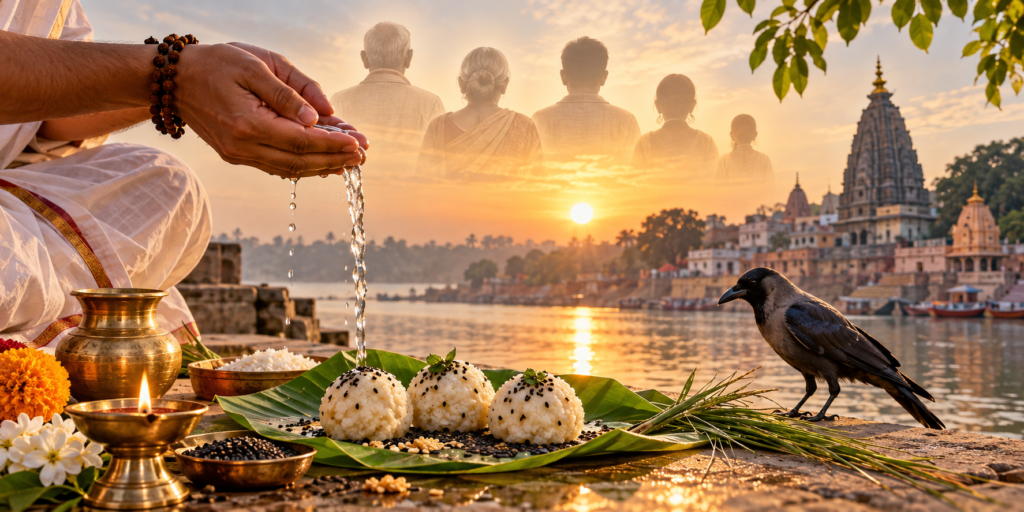
Pitru Paksha 2026 is a sacred period dedicated to remembering and honouring ancestors through Shraddha, Tarpan, Pind Daan, prayer and charity. Learn the complete Shraddha calendar, important rituals, Sarva Pitru Amavasya and the deeper spiritual meaning of this ancient tradition.
pitru-paksha-2026-shraddha-tarpan-pind-daan.jpg
Pitru Paksha is a sacred time to remember, honour and express gratitude to our ancestors. In 2026, the main Shraddha period begins on September 27 and ends with Sarva Pitru Amavasya on October 10.
There are festivals that fill our homes with music and celebration. Then there are sacred days that invite us to become quiet.
Pitru Paksha belongs to the second kind.
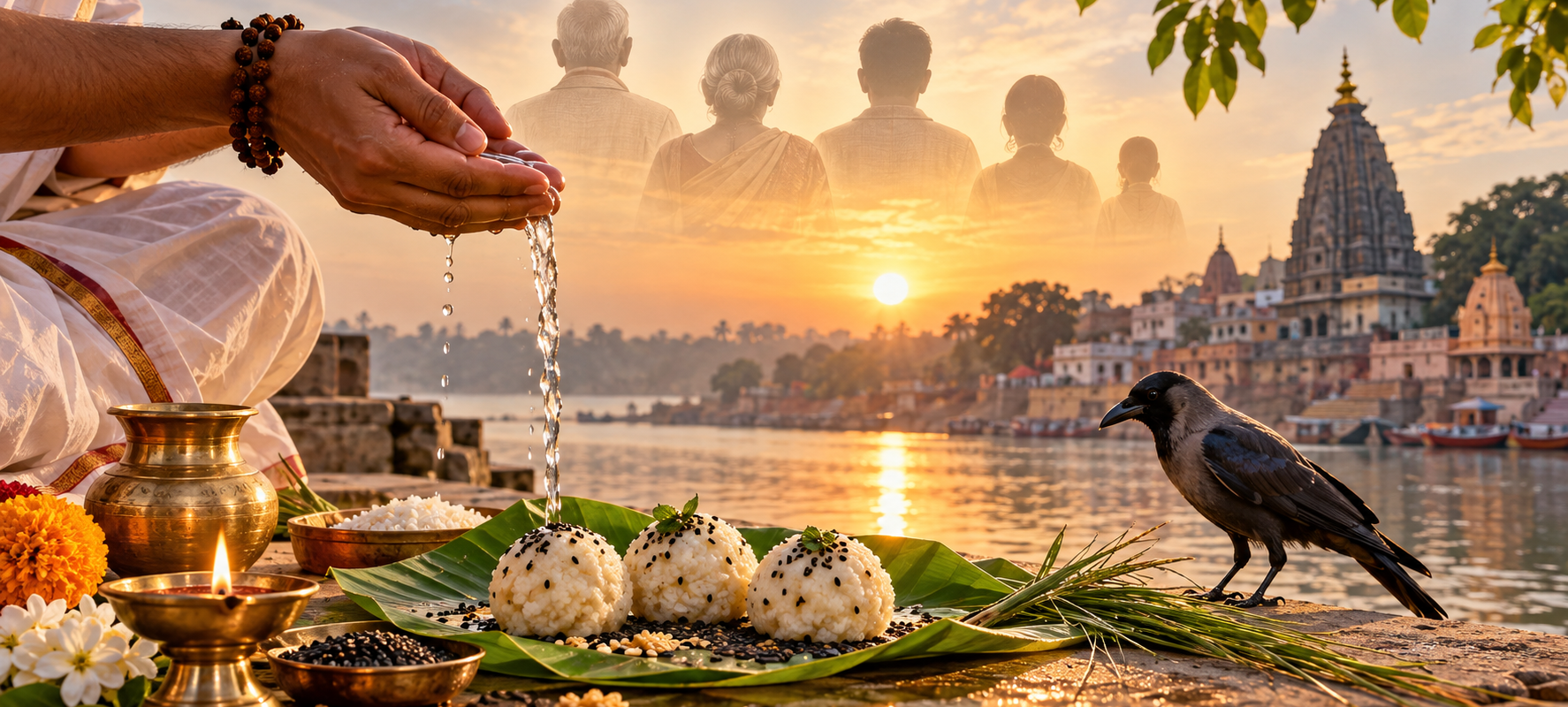
During this period, Hindu families remember their departed parents, grandparents and other ancestors. They offer water, food and prayers. Many families also perform Shraddha, Tarpan, Pind Daan and charity.
The rituals may look simple. However, they carry a deep message.
They remind us that our life did not begin with us. Generations came before us, and their choices, sacrifices and values helped shape the family we know today.
In 2026, Pitru Paksha begins with Pratipada Shraddha on September 27 and concludes with Sarva Pitru Amavasya on October 10. The day before, September 26, has Bhadrapada Purnima Shraddha. This distinction is important because some calendars include Purnima Shraddha when describing the wider Pitru Paksha period.
Let us understand the dates, rituals, traditions and deeper meaning of Pitru Paksha 2026.
Pitru Paksha 2026 at a Glance
| Detail | Information |
|---|---|
| Festival | Pitru Paksha 2026 |
| Also called | Shraddha Paksha, Pitra Paksha, Mahalaya Paksha |
| Purnima Shraddha | September 26, 2026 |
| Main Shraddha period | September 27 to October 10, 2026 |
| First main Shraddha | Pratipada Shraddha |
| Last day | Sarva Pitru Amavasya |
| Sarva Pitru Amavasya | October 10, 2026 |
| Main rituals | Shraddha, Tarpan, Pind Daan and Daan |
| Important pilgrimage place | Gaya, Bihar |
The exact ritual time depends on the city where the Shraddha is performed. Hindu Panchang calculations use local sunrise and tithi timings, so families should check a location-specific Panchang before fixing the ritual time.
When Is Pitru Paksha 2026?
The main Pitru Paksha Shraddha sequence begins on Sunday, September 27, 2026, with Pratipada Shraddha.
It ends on Saturday, October 10, 2026, with Sarva Pitru Amavasya.
There is one small detail that often causes confusion.
Bhadrapada Purnima Shraddha falls on September 26, 2026. The following day begins the main Krishna Paksha Shraddha sequence with Pratipada. Therefore, some calendars describe September 26 as the beginning of Pitru Paksha, while others list September 27 as the start of the main Shraddha period.
For readers searching specifically for the Pitru Paksha Shraddha tithi calendar, September 27 is the first main tithi.
Pitru Paksha 2026 Shraddha Dates
Here is the complete 2026 Shraddha calendar:
| Date | Day | Shraddha / Tithi |
|---|---|---|
| September 26 | Saturday | Bhadrapada Purnima Shraddha |
| September 27 | Sunday | Pratipada Shraddha |
| September 28 | Monday | Dwitiya Shraddha |
| September 29 | Tuesday | Tritiya Shraddha, Maha Bharani |
| September 30 | Wednesday | Chaturthi & Panchami Shraddha |
| October 1 | Thursday | Shashthi Shraddha |
| October 2 | Friday | Saptami Shraddha |
| October 3 | Saturday | Ashtami Shraddha |
| October 4 | Sunday | Navami Shraddha |
| October 5 | Monday | Dashami Shraddha |
| October 6 | Tuesday | Ekadashi Shraddha |
| October 7 | Wednesday | Dwadashi Shraddha, Magha Shraddha |
| October 8 | Thursday | Trayodashi Shraddha |
| October 9 | Friday | Chaturdashi Shraddha |
| October 10 | Saturday | Sarva Pitru Amavasya |
This calendar follows the 2026 Shraddha dates listed for Gaya and is consistent with broader 2026 Hindu calendar calculations.
Why do some dates have two Shraddhas?
You may notice that September 30 has Chaturthi and Panchami Shraddha, while October 7 has Dwadashi and Magha Shraddha.
This happens because Hindu festivals follow lunar tithis, not fixed Gregorian dates. A tithi can begin or end during a civil day.
For this reason, the Shraddha calendar does not always place one tithi neatly on one calendar date.
What Is Pitru Paksha?
The word Pitru refers to ancestors, while Paksha means a fortnight or lunar half.
Pitru Paksha is therefore the period traditionally dedicated to remembering and honouring one’s ancestors.
During these days, families perform rituals such as:
- Shraddha
- Tarpan
- Pind Daan
- Food offerings
- Charity
- Prayer
- Remembrance of departed family members
Bihar Tourism describes Pitra Paksha as a period reserved for paying homage to ancestors. The Ministry of Tourism also highlights Shraddha, Tarpan and Pind Daan as important practices connected with the observance.
The most important idea behind these rituals is gratitude.
We remember those who came before us and acknowledge the role they played in our lives.
Why Do Hindus Observe Pitru Paksha?
Hindu tradition places great importance on family lineage.
Parents give us life. Grandparents preserve family memories. Earlier generations pass down traditions, values, stories and knowledge.
Pitru Paksha gives families a special time to remember this connection.
During the period, people traditionally make offerings for departed family members. They also perform charity and other acts of kindness.
According to traditional belief, these actions honour the Pitrs and support their spiritual well-being. Bihar’s official tourism information also describes the observance in terms of ancestral remembrance and blessings.
At the same time, Pitru Paksha can be understood in a very personal way.
It gives us a chance to say:
“We remember you. We are grateful for what you gave us. Your place in our family story remains.”
What Is Shraddha?
Shraddha is the central ancestral ritual associated with Pitru Paksha.
The word is connected with the idea of faith, devotion and sincere reverence.
During Shraddha, families make traditional offerings for departed ancestors. Depending on the family tradition, the ritual may include:
- Water offerings
- Sesame seeds
- Pindas
- Cooked food
- Prayers
- Mantras
- Charity
- Feeding people
- Feeding animals
The exact procedure varies according to regional customs, family traditions and religious lineages.
Therefore, one family’s Shraddha ceremony may not look exactly like another family’s ceremony.
That does not make one tradition less meaningful.
What Is Tarpan?
Tarpan is a traditional offering of water.
During Pitru Paksha, devotees offer water while remembering their ancestors. Black sesame seeds are also commonly used.
The ritual expresses respect and gratitude toward the departed.
Ancient Hindu literature also refers to tilodaka, or water offered with sesame, in connection with ancestral rites. A passage from the Mahabharata’s Anushasana Parva discusses such sesame-water offerings.
For many families, Tarpan is one of the simplest yet most meaningful parts of Pitru Paksha.
A little water becomes a symbol of remembrance.
What Is Pind Daan?
Pind Daan is another important ancestral ritual.
A Pinda is traditionally a rounded offering, often prepared with rice and other prescribed ingredients.
The offering represents food and respect offered to the departed.
Families may perform Pind Daan at home according to their tradition. However, many pilgrims also travel to sacred places such as Gaya specifically for ancestral rites.
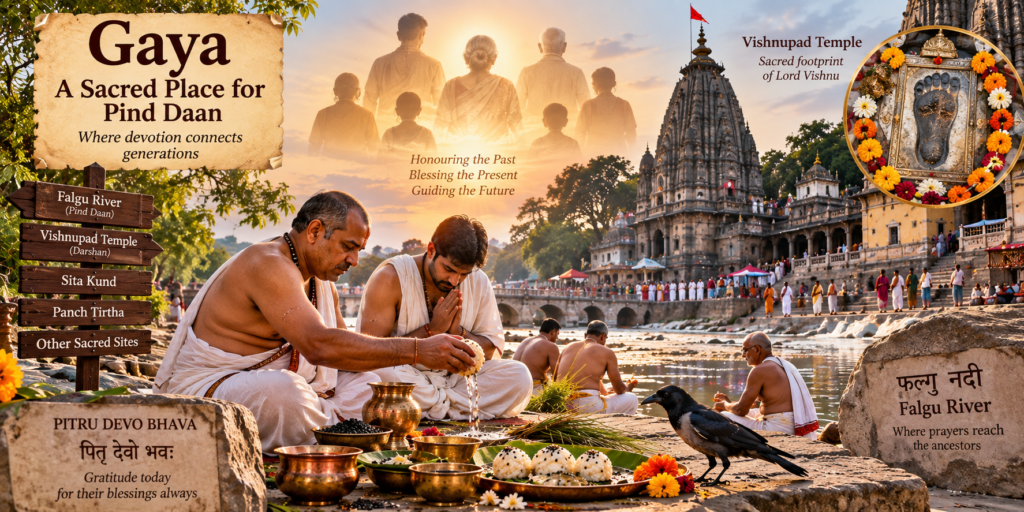
The Bihar Tourism Department identifies the Falgu River and Vishnupad Temple among important locations connected with Pind Daan in Gaya.
Why Is Gaya Important for Pind Daan?
gaya-pind-daan-pitru-paksha-falgu-river-vishnupad-temple.jpg
When people talk about Pitru Paksha, Gaya Ji in Bihar often comes to mind.
Gaya has a long-standing place in Hindu pilgrimage traditions connected with ancestors.
During Pitripaksha, pilgrims visit sacred locations in and around Gaya to perform Shraddha and Pind Daan.
Important places include:
- Falgu River
- Vishnupad Temple
- Sita Kund
- Panch Tirtha
- Other traditional pilgrimage sites
Bihar Tourism notes the importance of the Falgu River and Vishnupad Temple in the ancestral rites performed at Gaya.
The scale of the observance is also significant. Bihar’s official Pitripaksha Mela website lists the 2026 Gaya Pitripaksha Mela from September 25 to October 10.
The increased pilgrimage traffic is also reflected in railway arrangements. In September 2026, West Central Railway announced special trains between Rani Kamalapati and Gaya for the Pitru Paksha period.
The Story of Karna and Pitru Paksha
One of the most popular stories connected with Pitru Paksha is the story of Karna.
Karna was famous for his generosity. Throughout his life, he gave away wealth, jewellery and other valuable possessions.
According to the traditional story, Karna reached the heavenly realm after his death. However, he did not receive the food he expected.
He then learned that he had given many gifts during his lifetime but had not made food offerings for his ancestors.
Karna explained that he had not known enough about his ancestors to perform the appropriate rites.
The story says that he received an opportunity to return to Earth and perform Shraddha and make offerings.
This popular story is often used to explain why food, water and ancestral remembrance hold such an important place in Pitru Paksha traditions.
Its message goes beyond the ritual itself.
Giving to others is important. Remembering our own roots is important too.
What Are the Main Pitru Paksha Rituals?
main-pitru-paksha-rituals-shraddha-tarpan-pind-daan.jpg
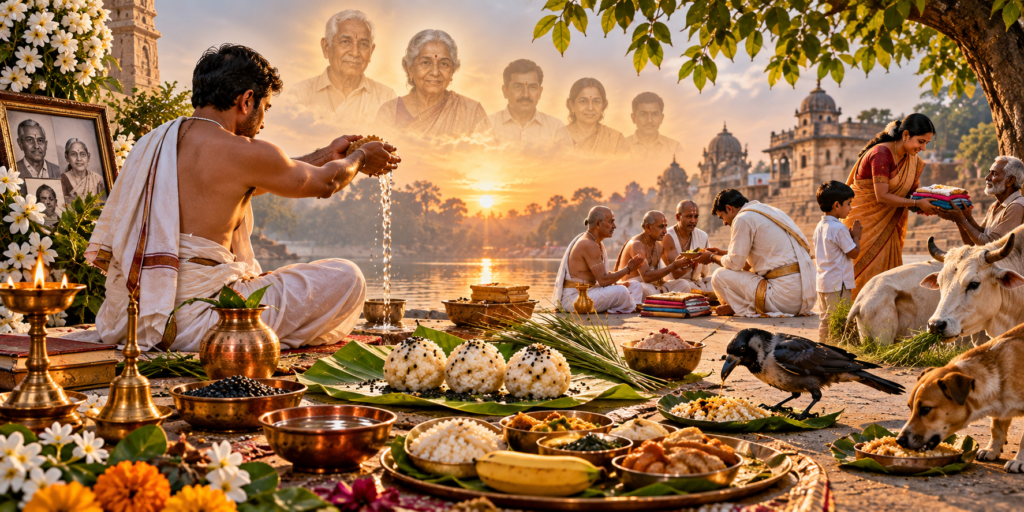
Different families follow different procedures. However, several practices are commonly associated with Pitru Paksha.
1. Sankalpa
The ritual usually begins with a Sankalpa.
A Sankalpa is a sacred intention. The person performing the ritual states the purpose of the ceremony and remembers the ancestor.
This step gives the ritual a clear spiritual purpose.
2. Tarpan
The devotee offers water to the ancestors.
Black sesame and Kusha grass may also be used according to the family tradition.
The person performing Tarpan remembers the departed ancestors with respect.
3. Pind Daan
The family prepares Pindas according to the prescribed ritual.
The Pindas are then offered as part of the ancestral ceremony.
The exact method can differ between traditions. Therefore, anyone performing formal Pind Daan for the first time should follow the guidance of their family priest or trusted Panchang tradition.
4. Shraddha Bhojan
Food has a special place in Shraddha.
Families traditionally prepare a simple meal and offer it according to their ritual customs.
Some traditions also include feeding Brahmins or other invited people.
The purpose is not simply to prepare an elaborate feast.
Instead, the meal becomes an expression of respect, service and generosity.
5. Daan and Charity
Charity is another important part of ancestral remembrance.
Families may donate:
- Food
- Grains
- Clothes
- Money
- Educational supplies
- Daily necessities
The donation does not have to be extravagant.
Even a small act of genuine generosity can carry meaning when it comes from the heart.
Why Are Crows Fed During Pitru Paksha?
A familiar Pitru Paksha tradition involves offering food to a crow.
Why a crow?
In several Hindu traditions, crows are associated symbolically with ancestors and Yama. Because of this association, feeding crows became part of ancestral observances in many communities.
Families may place a portion of the prepared food outside and wait for a crow to eat it.
This should be understood as a religious and cultural tradition, rather than as a scientific test of whether an offering has reached an ancestor.
The practice continues because it has become an important part of ancestral remembrance for many Hindu families.
Why Is Black Sesame Used During Pitru Paksha?
Black sesame, or til, has a long history in Hindu rituals.
It is especially common in Tarpan and other ancestral offerings.
Ancient texts refer to sesame-water offerings in connection with rites for the ancestors.
For this reason, black sesame remains an important item in many Pitru Paksha rituals today.
Why Is Kusha Grass Used?
Kusha grass has an important place in traditional Hindu rituals.
People use it in several Vedic and ritual practices. During Tarpan and Shraddha, Kusha may be used according to the prescribed method.
The exact procedure differs between traditions.
Therefore, it is better to follow the method taught by your family priest instead of combining instructions from different ritual systems.
What Food Is Prepared During Pitru Paksha?
Food traditions vary from one family to another.
However, Shraddha meals are generally simple and vegetarian.
Common preparations may include:
- Rice
- Dal
- Roti
- Seasonal vegetables
- Kheer
- Fruits
- Halwa
- Puri
- Sesame-based preparations
Some families also prepare a dish that their departed family member particularly liked.
That small personal touch can make the day deeply emotional.
Food becomes more than food.
It becomes a memory.
What Should You Avoid During Pitru Paksha?
Pitru Paksha is traditionally treated as a period of remembrance rather than celebration.
Because of this, many families avoid major celebrations and auspicious ceremonies during these days.
Commonly followed practices include avoiding:
- Weddings
- Large celebrations
- Griha Pravesh
- Major festive functions
- Alcohol and intoxicants
- Extravagant entertainment
Dietary rules also vary.
Some families follow a strictly sattvic diet. Others avoid specific ingredients such as onion, garlic or certain pulses.
Bihar Tourism, for example, lists several food restrictions followed in its local Pitra Paksha tradition. However, these rules should not automatically be treated as universal rules for every Hindu household.
Family tradition matters.
If your household follows a particular Shraddha tradition, it is best to continue that practice.
Can You Buy New Things During Pitru Paksha?
This question often creates unnecessary worry.
Traditionally, many families avoid unnecessary luxury purchases and major auspicious beginnings during Pitru Paksha.
The reason is simple.
These days focus on remembrance, simplicity and ancestral duties, rather than celebration.
However, essential purchases are different.
If you need groceries, medicines, school supplies or something necessary for everyday life, there is no reason to turn the period into a source of anxiety.
The emphasis should remain on remembrance and sincerity.
Is Fasting Necessary During Pitru Paksha?
There is no single fasting rule that applies to every family.
Some people follow dietary restrictions. Others do not observe a formal fast.
Pitru Paksha focuses primarily on Shraddha, remembrance, Tarpan, charity and ancestral offerings.
Therefore, people should follow the fasting or dietary practice prescribed by their own family tradition.
Can Women Perform Shraddha?
Customs regarding who performs Shraddha vary between families and communities.
In many traditional households, a son or another male family member performs the principal ceremony.
However, other families follow different customs.
Therefore, it is better to avoid saying that only one particular group can perform ancestral rites.
If your family has no traditional male performer, or if you are unsure about the correct practice, consult your family priest or your established ritual tradition.
The purpose remains the same:
to honour the ancestors with sincerity.
What Is the Best Time to Perform Shraddha?
Shraddha is traditionally performed during the Aparahna period, with specific Muhurats such as Kutup and Rohina also used in traditional Panchang calculations.
However, the exact time changes according to location.
For example, the 2026 Pratipada Shraddha timing listed for Pilani places Kutup Muhurat at 11:54 AM–12:42 PM and Aparahna Kaal at 1:30 PM–3:54 PM. A different city will have different timings.
Similarly, the 2026 Amavasya Shraddha timings vary by location.
Therefore:
Do not copy Shraddha timings from another city.
Always check the local Panchang for the place where you will perform the ritual.
What If You Do Not Know the Ancestor’s Death Tithi?
This is a common situation.
Sometimes family records are missing. In other cases, younger generations know the date of death but not the lunar tithi.
Traditionally, Sarva Pitru Amavasya is especially important for remembering ancestors when the specific Shraddha tithi is unknown.
The day also provides an opportunity to remember multiple ancestors together.
In 2026, Sarva Pitru Amavasya falls on:
Saturday, October 10, 2026
The Amavasya Shraddha is traditionally associated with Amavasya deaths, and Panchang sources also identify it as the concluding day of the Pitru Paksha sequence.
What Is Sarva Pitru Amavasya?
Sarva Pitru Amavasya is the final day of Pitru Paksha.
It is also called:
- Mahalaya Amavasya
- Sarvapitri Amavasya
- Mahalaya
The name itself reflects the broad purpose of the day: remembering ancestors collectively.
For families that do not know the exact death tithi of an ancestor, this day has special importance.
It also serves as the final opportunity in the Pitru Paksha cycle for families to complete their ancestral observances.
Pitru Paksha 2026: Why Is the Final Day Special?
The final day carries a feeling of closure.
For almost two weeks, families remember different ancestors according to their respective tithis.
Then comes Amavasya.
On this day, families can offer prayers for ancestors collectively.
The 2026 calendar places Sarva Pitru Amavasya on October 10, with Sharad Navratri beginning the following day, October 11.
This creates a natural transition in the Hindu calendar:
Pitru Paksha ends, and the festive Sharad season begins.
What Is Pitru Rin?
Hindu philosophy speaks about different forms of responsibility or Rin, including the idea of Pitru Rin, the responsibility or debt toward one’s ancestors.
Think about it this way.
We inherit much more than a family name.
We inherit language.
We inherit traditions.
We inherit recipes.
We inherit stories.
We inherit values.
We inherit the lessons of people we may never have met.
Pitru Paksha provides a sacred space to acknowledge that inheritance.
Is Pitru Paksha Only About Death?
Not really.
At first glance, Pitru Paksha may seem to be entirely about death.
Look a little deeper, though, and another theme appears.
It is also about life and continuity.
Every family is a bridge between generations.
Someone lived before us.
We live today.
Someone will come after us.
Pitru Paksha reminds us that we are one part of this larger story.
That is why the period can feel solemn without being negative.
It is a time to remember.
Pitru Paksha and Pitru Dosha
The term Pitru Dosha appears frequently in discussions about ancestral traditions.
Some Hindu traditions associate ancestral dissatisfaction with difficulties in family life and recommend rituals for relief from Pitru Dosha.
Official Bihar tourism material also connects Pitra Paksha rituals with the belief in removing Pitru Dosha.
However, Pitru Paksha does not need to be viewed only through fear.
Its deeper theme is Shraddha.
That means respect, faith and remembrance.
Rather than worrying about whether every small ritual has been performed perfectly, families can focus on the spirit behind the observance.
Can Pitru Paksha Rituals Be Performed at Home?
Yes.
Many families perform ancestral prayers and simple rituals at home.
A basic observance may include:
- Taking a bath and wearing clean clothes.
- Cleaning the prayer area.
- Remembering the ancestor.
- Making a Sankalpa.
- Offering Tarpan according to family tradition.
- Preparing the prescribed food.
- Offering food or Pinda as appropriate.
- Performing charity.
- Offering food to animals according to family custom.
- Ending the ritual with prayers.
However, formal Shraddha and Pind Daan procedures can involve detailed rules.
If you are performing an important ancestral ceremony for the first time, guidance from a knowledgeable priest can be helpful.
A Simple Way to Observe Pitru Paksha at Home
Not every family has the ability to perform a large ceremony.
That does not mean the period has to pass without remembrance.
You can keep the day simple.
In the morning
Take a bath and clean the prayer space.
During the ritual
Remember your ancestors by name.
If you know the traditional Tarpan procedure, perform it according to your family custom.
Prepare a simple meal
Cook vegetarian food with care and offer it according to your tradition.
Give something to someone in need
Donate food, clothes, grains or another useful item.
Spend a few quiet minutes remembering
Look at an old photograph.
Remember a story.
Think about something your ancestor taught your family.
Sometimes that quiet moment can become the most meaningful part of the entire day.
Pitru Paksha 2026: Important Dates at a Glance
September 26, 2026
Bhadrapada Purnima Shraddha
September 27, 2026
Pratipada Shraddha
September 28, 2026
Dwitiya Shraddha
September 29, 2026
Tritiya Shraddha and Maha Bharani
September 30, 2026
Chaturthi and Panchami Shraddha
October 1, 2026
Shashthi Shraddha
October 2, 2026
Saptami Shraddha
October 3, 2026
Ashtami Shraddha
October 4, 2026
Navami Shraddha
October 5, 2026
Dashami Shraddha
October 6, 2026
Ekadashi Shraddha
October 7, 2026
Dwadashi and Magha Shraddha
October 8, 2026
Trayodashi Shraddha
October 9, 2026
Chaturdashi Shraddha
October 10, 2026
Sarva Pitru Amavasya / Mahalaya Amavasya
These dates are based on the 2026 Shraddha calendar for Gaya and should be paired with local Panchang timings when publishing exact ritual Muhurats.
Frequently Asked Questions About Pitru Paksha 2026
When does Pitru Paksha start in 2026?
The main Pitru Paksha Shraddha sequence begins on September 27, 2026, with Pratipada Shraddha. Bhadrapada Purnima Shraddha takes place on September 26.
When does Pitru Paksha end in 2026?
Pitru Paksha ends on October 10, 2026, with Sarva Pitru Amavasya.
What is Sarva Pitru Amavasya?
Sarva Pitru Amavasya is the final Amavasya of Pitru Paksha. It is especially important for collective ancestral remembrance and for cases where the specific death tithi is unknown.
Which tithi should I choose for Shraddha?
Traditionally, families perform Shraddha on the lunar tithi of the ancestor’s death.
For example, an ancestor who passed away on Krishna Paksha Ashtami would traditionally be remembered on Ashtami during Pitru Paksha.
What if I do not know the death tithi?
Sarva Pitru Amavasya is traditionally an important day for remembering ancestors whose specific tithi is unknown.
What is the difference between Shraddha and Tarpan?
Shraddha is the broader ancestral ritual. It can include food offerings, Pind Daan, prayers and charity.
Tarpan specifically refers to offering water, often with sesame, to the ancestors.
What is Pind Daan?
Pind Daan is a traditional ancestral offering involving Pindas, commonly prepared with rice and other prescribed ingredients.
Why is Gaya important during Pitru Paksha?
Gaya is one of the most important Hindu pilgrimage centres for ancestral rites. Pilgrims traditionally visit places such as the Falgu River and Vishnupad Temple for Shraddha and Pind Daan.
Can Pitru Paksha rituals be performed at home?
Yes. Many families perform ancestral rituals at home. The exact procedure depends on family tradition.
Is fasting compulsory during Pitru Paksha?
No single fasting rule applies to every family. Dietary practices vary according to tradition.
Can women perform Shraddha?
Customs differ among families and communities. If there is uncertainty, follow your family’s tradition or consult a knowledgeable priest.
Why do people feed crows during Pitru Paksha?
Many Hindu traditions symbolically associate crows with ancestors and Yama. Feeding crows therefore became part of ancestral observance in many communities.
Can we buy new things during Pitru Paksha?
Many families avoid unnecessary luxury purchases and major auspicious beginnings. Essential purchases for everyday needs are a different matter.
What food is prepared during Shraddha?
Families commonly prepare simple vegetarian food such as rice, dal, vegetables, kheer, fruits and other traditional dishes. The exact menu varies by region and family.
Final Thoughts: The Quiet Beauty of Pitru Paksha
Pitru Paksha does not arrive with the noise of a grand festival.
There are no colourful processions in most homes.
Instead, there may be a diya burning quietly in a corner.
There may be a bowl of water.
A few sesame seeds.
A simple meal.
An old photograph.
And a name that has not been spoken for a long time.
That is the beauty of Pitru Paksha.
It gives us permission to remember.
We remember our parents.
We remember our grandparents.
We remember relatives whose voices have faded from our homes but whose influence remains.
Most importantly, we remember that every family is part of a much longer story.
Pitru Paksha 2026 begins its main Shraddha sequence on September 27 and concludes with Sarva Pitru Amavasya on October 10.
The rituals may differ from one family to another.
The food may be different.
The prayers may be different.
Even the method of Shraddha may differ.
Yet the heart of the tradition remains beautifully simple:
Remember your roots.
Honour those who came before you.
Give with compassion.
And carry their good values into the next generation.
Perhaps that is the most meaningful offering we can make.
Not only a ritual for our ancestors, but a good life built upon what they gave us.
ॐ पितृभ्यो नमः।
If this story moved you, share it.
Explore more in Festival →