Chhath Puja 2026 will be observed from November 13 to 16. Explore its four-day rituals, Arghya timings, puja samagri, mythology, prasad and the deeper spiritual meaning of this sacred festival.
chhath-puja-2026-featured-image.jpg
There is something deeply moving about Chhath Puja.
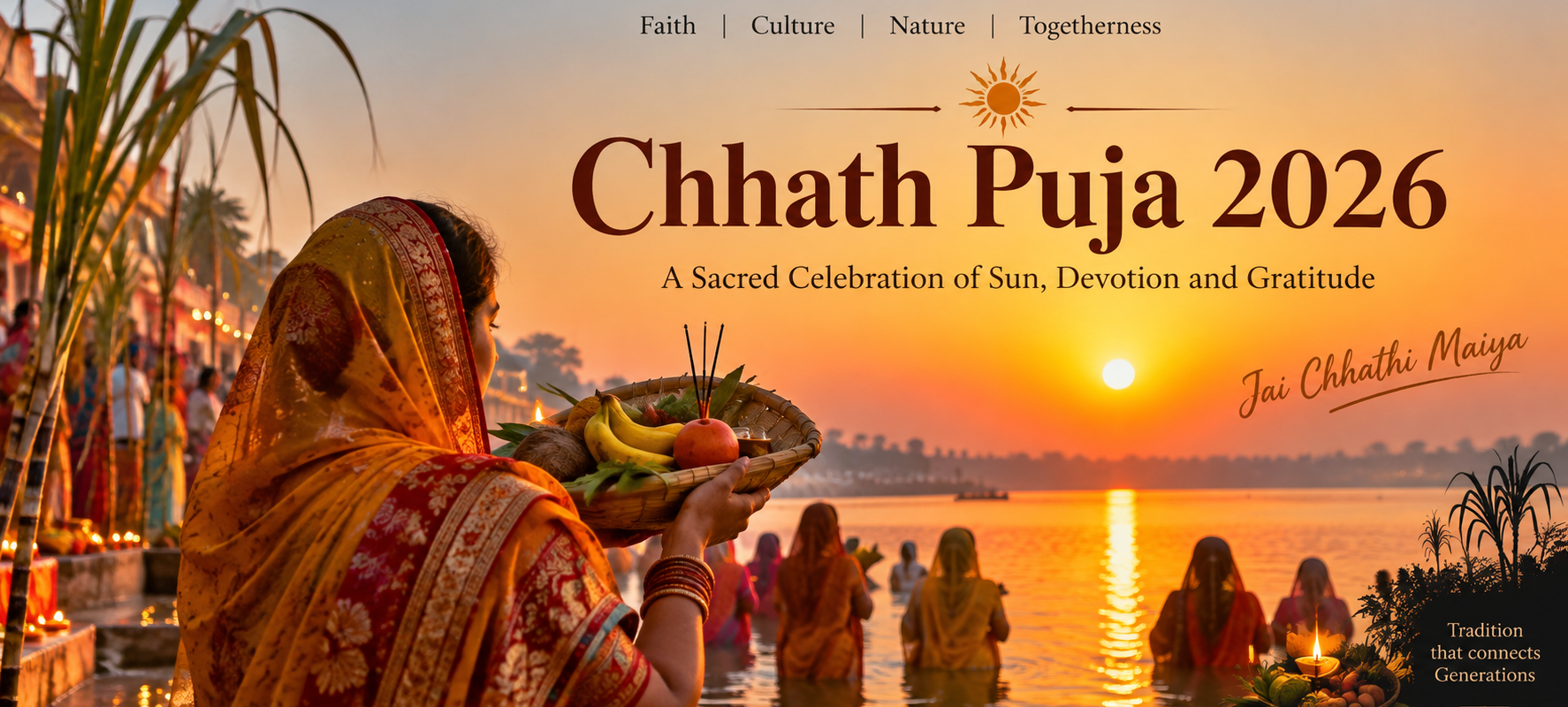
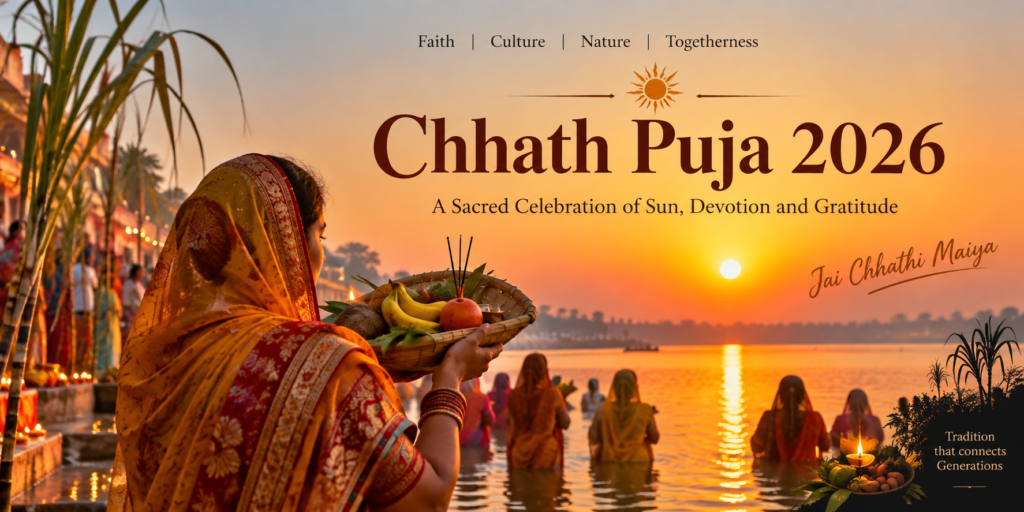
As the sun begins to disappear over the horizon, hundreds and thousands of devotees stand quietly in the water, holding bamboo baskets filled with fruits, sugarcane, thekua and diyas. There is no elaborate temple ceremony. No grand idol procession. No priest standing between the devotee and the deity.
There is simply the devotee, the river, the setting sun and a prayer.
The next morning, before sunrise, the same devotees return to the water. After keeping one of the most demanding fasts in Hindu tradition, they offer Usha Arghya to the rising Sun and finally break their fast.
This is what makes Chhath so distinctive. It is a festival of Surya worship, nature, discipline, gratitude and community, deeply rooted in the cultural traditions of Bihar, Jharkhand, eastern Uttar Pradesh and Nepal. Today, Chhath is also celebrated with great devotion in Delhi-NCR, Mumbai, Gujarat, Maharashtra and by Indian communities across the world.
And in 2026, Chhath Puja will once again bring devotees together over four sacred days.
Chhath Puja 2026: At a Glance
| Day | Date | Ritual |
|---|---|---|
| Day 1 | Friday, 13 November 2026 | Nahay Khay |
| Day 2 | Saturday, 14 November 2026 | Kharna / Lohanda |
| Day 3 | Sunday, 15 November 2026 | Sandhya Arghya |
| Day 4 | Monday, 16 November 2026 | Usha Arghya and Parana |
The main Chhath Puja falls on Sunday, 15 November 2026, when devotees offer Sandhya Arghya to the setting Sun. The festival concludes the following morning, 16 November, with Usha Arghya to the rising Sun.
The four-day sequence is also listed by the Government of India’s Incredible India tourism portal as 13–16 November 2026.
What Is Chhath Puja?
Chhath Puja, also called Chhath, Chhathi, Chhath Parv, Dala Chhath or Surya Shashthi, is a Hindu festival dedicated primarily to Surya Dev, the Sun God, along with the worship associated with Chhathi Maiya/Shashthi Devi in regional traditions.
The festival is particularly associated with Bihar, Jharkhand, eastern Uttar Pradesh and Nepal, although its observance has spread far beyond these regions.
Unlike many Hindu festivals that centre around an image or idol, Chhath places nature itself at the heart of worship.
The Sun provides light and energy. Water is essential for life. The earth gives food. Plants provide fruits and grains. Bamboo becomes the traditional soop and daura used for offerings.
Even the physical setting of the festival reflects this relationship with nature.
The Bihar government’s description of Chhath highlights its emphasis on purity, discipline, direct worship and community participation. It also notes the unusual importance given to the setting Sun, not only the rising Sun.
That simple idea carries a surprisingly profound message: gratitude should not be reserved only for what is rising and flourishing; what is setting also deserves respect.
When Is Chhath Puja 2026?
In 2026, the main Chhath Puja will be observed on:
Sunday, 15 November 2026
However, Chhath is not a one-day festival. The complete observance begins on 13 November and ends on 16 November 2026.
The four days are:
13 November – Nahay Khay
14 November – Kharna
15 November – Sandhya Arghya
16 November – Usha Arghya and Parana
The main Shashthi observance occurs on 15 November. According to the Patna Panchang reference, Shashthi begins late on 14 November and extends into the early hours of 16 November.
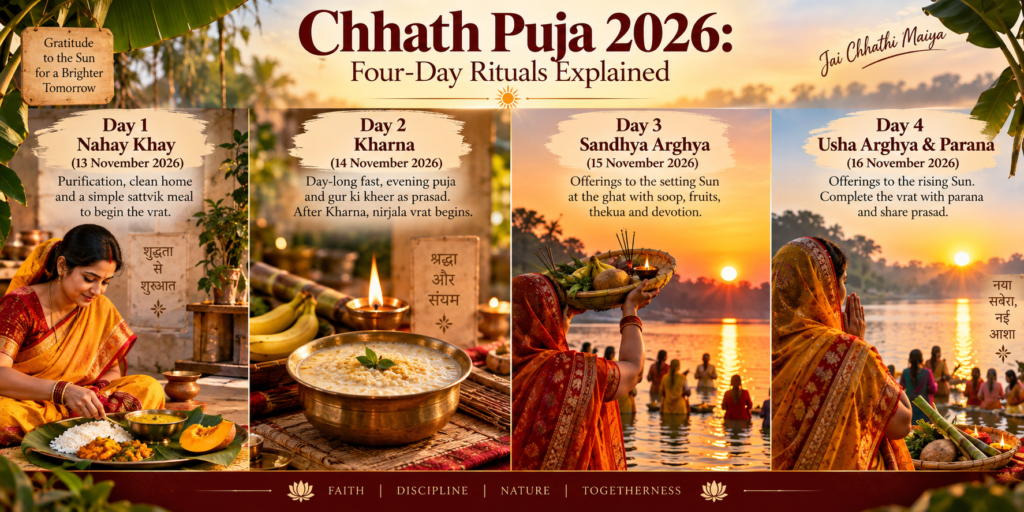
Chhath Puja 2026: Four-Day Rituals Explained
chhath-puja-2026-featured-image.jpg
The beauty of Chhath lies in its gradual rhythm. Each day prepares the devotee for the next.
Day 1 – Nahay Khay
Friday, 13 November 2026
Chhath begins with Nahay Khay, literally associated with bathing and eating.
The day is about purification.
Devotees traditionally take a holy bath, often at a river, pond or other clean water body. Homes and the areas where food and puja preparations will take place are thoroughly cleaned.
The person observing the vrat, commonly called the vrati, then takes a simple satvik meal.
Traditional preparations may include arwa rice, chana dal and pumpkin sabzi, although specific food customs vary from family to family and region to region. Historical Bihar government material records this combination as part of the traditional Nahay Khay meal.
The idea is not indulgence.
It is preparation.
From this point onwards, the vrati follows increasingly strict rules of purity and restraint.
Day 2 – Kharna
Saturday, 14 November 2026
The second day is known as Kharna, also called Lohanda in some traditions.
This is when the discipline of the vrat becomes much more intense.
The vrati observes a day-long fast and traditionally breaks it after sunset following the evening ritual.
One of the most familiar Kharna offerings is gur ki kheer, generally prepared with rice, jaggery and milk. Fruits and other traditional preparations may also accompany the offering.
After the offering, the prasad is shared with family members and others.
But Kharna is not the end of the fast.
Quite the opposite.
After taking the Kharna prasad, the traditional nirjala vrat begins. The next stretch continues until the morning Arghya on the fourth day.
This is why Chhath is often described as involving a roughly 36-hour waterless fast.
Because such fasting is physically demanding, anyone considering it should follow their family’s established tradition and take personal health circumstances seriously rather than treating the fast as a test of endurance.
Day 3 – Sandhya Arghya
Sunday, 15 November 2026
This is the day when the familiar image of Chhath comes alive.
The vrati prepares the offerings and carries them to the ghat in a soop or daura, traditionally made from bamboo.
The basket may contain:
- Thekua
- Fruits
- Sugarcane
- Coconut
- Rice-based offerings
- Seasonal fruits
- Diyas
- Other traditional puja items
As evening approaches, devotees gather beside rivers, ponds, lakes or specially prepared water bodies.
And then comes the central moment:
Sandhya Arghya — offering to the setting Sun.
The vrati stands in the water and offers arghya to Surya Dev as the sun touches the horizon.
It is one of the most striking aspects of Chhath.
The setting Sun is worshipped before the rising Sun.
The Bihar Tourism Department describes this as one of the distinctive features of Chhath Puja.
Chhath Puja 2026 Sandhya Arghya Timing
There is an important detail here that many online articles get wrong.
There is no single sunset time for all of India.
The Sandhya Arghya is tied to the local sunset.
For example:
- Delhi: approximately 5:26–5:27 PM
- Patna: approximately 5:01 PM
- Kolkata: approximately 4:51 PM
- Varanasi: approximately 5:09 PM
These times are location-specific and should be treated as reference values rather than a substitute for the local Panchang or actual sunset conditions.
For your own city, it is sensible to reach the ghat well before sunset.
The point of Sandhya Arghya is the actual setting Sun—not a generic clock time copied from another city.
The Night of Kosi
chhath-puja-2026-featured-image.jpg
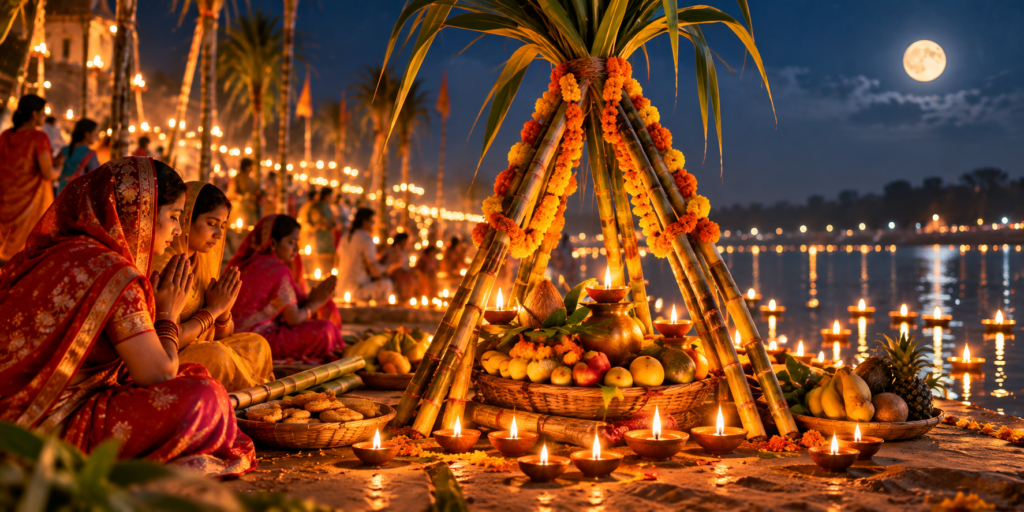
In many Chhath traditions, the night following Sandhya Arghya includes Kosi, an especially beautiful ritual.
A small canopy or structure is traditionally created using sugarcane stalks. Earthen lamps and offerings are placed underneath it.
The illuminated sugarcane structure, surrounded by the quiet atmosphere of the ghat or home courtyard, gives the night a special character. Bihar Tourism also describes Kosi as part of the Chhath observance.
However, Kosi is not performed in exactly the same way by every family. Customs can vary according to region, community and family tradition.
Day 4 – Usha Arghya and Parana
Monday, 16 November 2026
The final morning begins before sunrise.
After spending the night observing the fast, devotees return to the ghat.
The atmosphere is completely different from the previous evening.
The sky is still dark.
The water is quiet.
Then the first light appears.
As the Sun rises, devotees offer Usha Arghya.
This is the final major ritual of Chhath.
After the morning Arghya, the vrati performs Parana, or breaks the fast, according to the family’s tradition.
Prasad is then shared with family, friends, neighbours and other devotees.
Usha Arghya Timing in 2026
Again, the timing depends on the city.
For Delhi, the 16 November 2026 sunrise is approximately 6:45 AM according to city-specific calculations.
For Patna, the corresponding sunrise is around 6:07 AM.
So if you’re preparing a Chhath Puja article for a national audience, it is better to write:
Usha Arghya is offered at sunrise on Monday, 16 November 2026. The exact time varies according to location.
That is much more accurate than presenting one city’s sunrise as the timing for everyone.
Why Is the Setting Sun Worshipped During Chhath?
This is perhaps the most beautiful question associated with Chhath.
In everyday language, we often celebrate success, beginnings and rising fortunes.
But Chhath asks devotees to pause before the setting Sun too.
The setting Sun represents a moment of transition. It reminds us that every rise is followed by a setting, and every setting prepares the way for another dawn.
The tradition has also been interpreted as a social message: respect is not meant only for those at the height of their power or success.
Official commentary on Chhath has repeatedly highlighted this unusual reverence for both the setting and rising Sun.
There is something wonderfully grounded about that idea.
The festival does not ask us to worship only the moment of arrival.
It teaches us to bow to the entire cycle.
Who Is Chhathi Maiya?
Chhath is associated not only with Surya Dev but also with Chhathi Maiya, often identified in regional traditions with Shashthi Devi.
There are several traditions and explanations surrounding Chhathi Maiya, and they are not completely uniform across all communities.
Some traditional accounts describe her as connected with the protection of children and family well-being.
Other traditions connect her with Shashthi Devi and the wider worship of nature and fertility.
Because these stories exist in different oral and regional forms, it is better not to present one later folklore account as the single historical explanation for the festival.
What remains common is the central devotional framework: gratitude to Surya, reverence for nature, discipline, purity and prayers for family well-being.
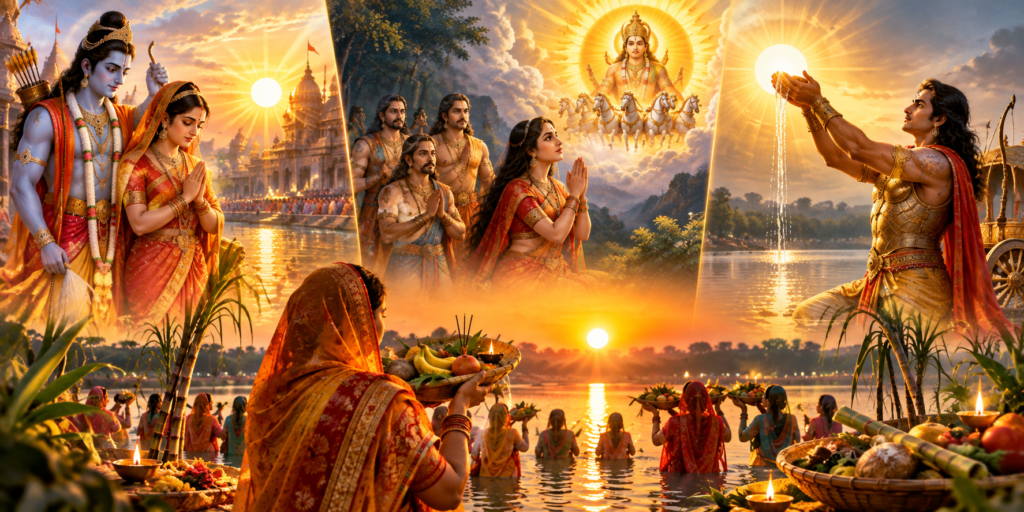
The Mythological Stories Associated With Chhath Puja
chhath-puja-2026-featured-image.jpg
Chhath does not have one universally accepted origin story.
Instead, several traditions are associated with the festival.
Lord Rama and Goddess Sita
One popular belief connects the festival with Lord Rama and Goddess Sita.
According to this tradition, after returning to Ayodhya following their victory over Ravana, Rama and Sita observed a fast and worshipped Surya.
This story is part of the traditional explanations associated with Chhath, although it should be understood as a religious tradition rather than as a historically established account of the festival’s origin.
Draupadi and the Pandavas
Another popular tradition connects Chhath with Draupadi and the Pandavas.
According to the story, during the Pandavas’ exile, Draupadi sought help in overcoming their difficulties and was advised to worship the Sun.
The tradition associates her devotion to Surya with the eventual resolution of their troubles.
Karna and Surya Dev
The Mahabharata’s Karna, traditionally regarded as the son of Surya, is also strongly associated with Sun worship.
Traditional accounts describe Karna as a devoted worshipper of the Sun and as one who performed elaborate acts of worship and charity.
This association helps explain why Karna frequently appears in discussions of the ancient traditions surrounding Surya worship.
But again, these epic associations should not automatically be treated as proof that modern Chhath began with Karna.
Is Chhath Puja an Ancient Vedic Festival?
Chhath is widely described by government tourism sources as having ancient Vedic roots and as being deeply connected with traditional Sun worship.
The worship of Surya is certainly ancient within Hindu religious literature, and references to Sun worship occur in Vedic traditions.
However, the precise historical development of the modern four-day Chhath observance is more complicated.
It is safer to say that Chhath belongs to a long tradition of Indian Sun worship and nature reverence rather than claiming that every modern ritual existed in exactly the same form thousands of years ago.
That distinction makes the history more honest—and, in my view, more interesting.
Why Is Chhath Called a Festival of Nature?
Chhath is unusually connected to the natural world.
Think about the basic ingredients of the festival:
Sunlight.
Water.
Earth.
Fruits.
Grains.
Bamboo.
Clay.
Sugarcane.
The Sun is worshipped directly.
Water bodies become sacred spaces.
Bamboo becomes the soop and daura.
Earthen diyas illuminate the ghats.
Seasonal produce becomes an offering.
The festival therefore creates a powerful relationship between spirituality and the natural resources that sustain everyday life.
The Prime Minister’s official remarks on Chhath have also highlighted its relationship with Sun, water, bamboo, clay, cleanliness and environmental awareness.
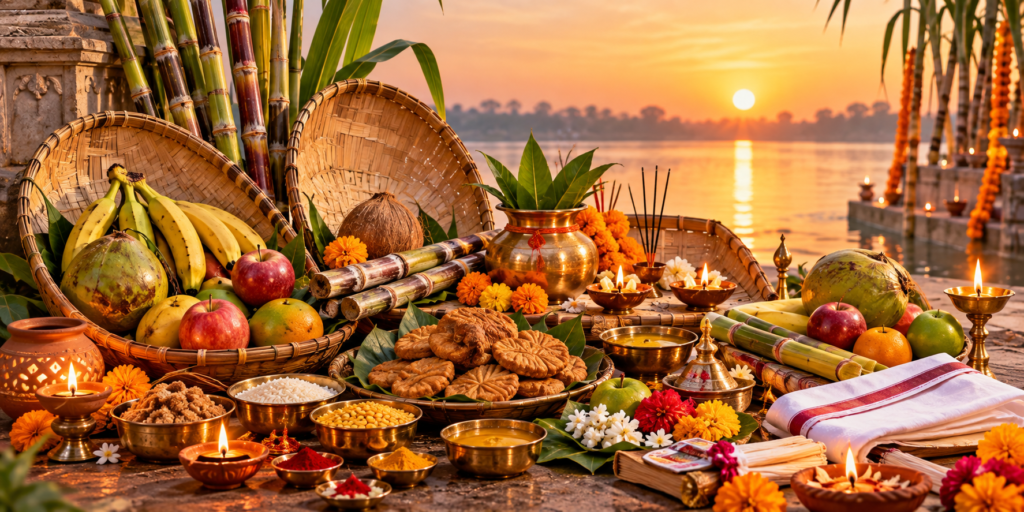
Chhath Puja Samagri List 2026
chhath-puja-2026-featured-image.jpg
The exact list varies from household to household, but a traditional Chhath preparation may include:
Main Puja Items
- Bamboo soop
- Bamboo daura
- Kalash
- Diya
- Cotton wicks
- Ghee or oil
- Gangajal
- Flowers
- Kumkum
- Sindoor
- Rice
- Roli
- Sandalwood, according to family tradition
Fruits
- Banana
- Coconut
- Sugarcane
- Apple
- Orange or sweet lime
- Lemon
- Pomegranate
- Seasonal fruits
Traditional Prasad
- Thekua
- Gur
- Rice
- Kheer
- Rice laddoo
- Kasar, in some traditions
- Rasia
- Puri, according to regional practice
Bihar’s official tourism material identifies thekua as one of the signature Chhath offerings.
Why Is Thekua So Important in Chhath?
chhath-puja-2026-featured-image.jpg
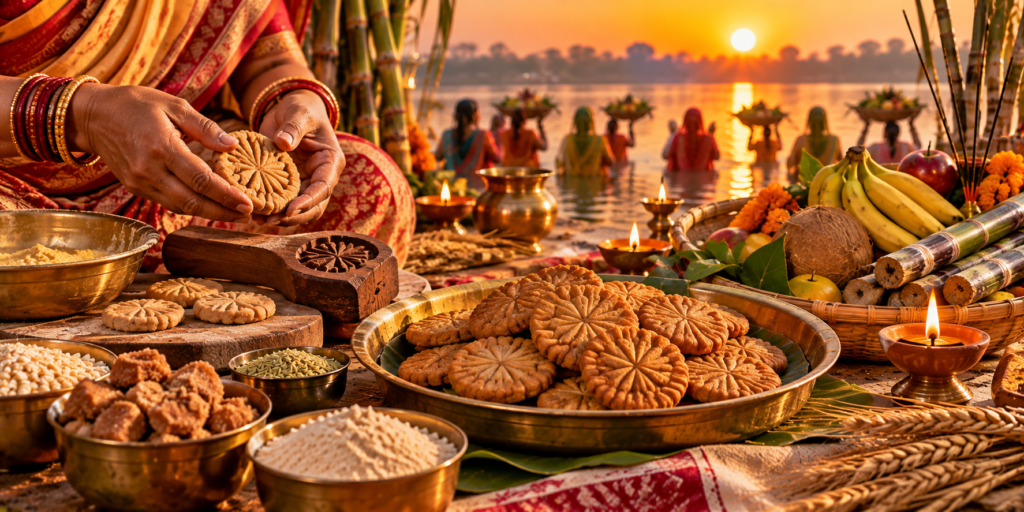
If there is one food that immediately reminds people of Chhath, it is thekua.
Made traditionally from wheat flour, jaggery and ghee, thekua is shaped using a wooden mould known as a saancha.
Coconut, fennel and cardamom may also be added depending on the recipe.
Bihar Tourism describes thekua as a traditional Bihari sweet and specifically notes its association with Chhath Puja prasad.
But thekua is more than a festive sweet.
It carries memory.
For many families, making thekua is a collective activity. Someone prepares the dough, someone shapes it, someone fries it and someone carefully arranges the finished pieces for the soop.
That is one reason Chhath feels less like a festival that you simply attend and more like a festival that an entire family builds together.
What Is Offered in the Chhath Soop?
The traditional soop or daura is filled with offerings.
Common items include:
- Thekua
- Bananas
- Coconut
- Sugarcane
- Rice preparations
- Seasonal fruits
- Diyas
- Other locally customary offerings
Bamboo itself has symbolic and practical importance in the festival.
The use of natural materials is one of the details that makes Chhath visually and culturally distinctive.
Why Do Devotees Stand in Water During Chhath?
chhath-puja-2026-featured-image.jpg
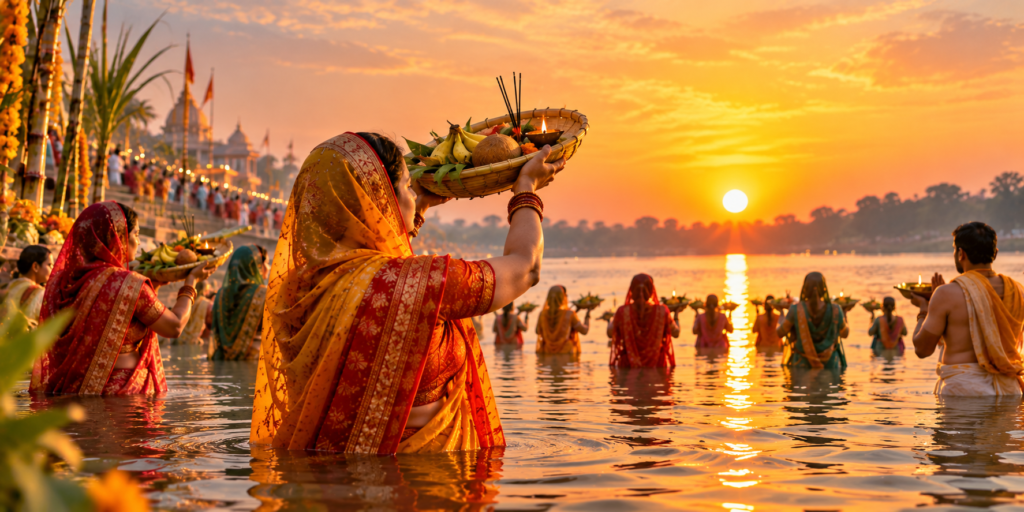
Standing in water during Arghya is one of the most recognizable rituals of Chhath.
Devotees traditionally enter the water and offer Arghya toward the setting or rising Sun.
The ritual connects three natural elements in one moment:
Sun + Water + Human devotion
The practice also reflects the historical relationship between agrarian communities, rivers and seasonal cycles.
It is important, however, not to reduce this to a modern scientific claim that the ritual itself “cures diseases” or has medically proven benefits. Such claims belong to religious belief and tradition, not established medical evidence.
Why Is Chhath Puja Considered So Strict?
Chhath has a reputation for extraordinary discipline.
The vrat involves:
- Cleanliness
- Dietary restrictions
- Ritual purity
- Controlled food intake
- Long periods of fasting
- In traditional observance, a prolonged waterless fast
- Standing in water during Arghya
- Waking before sunrise
- Careful preparation of prasad
The Government of Bihar describes Chhath as one of the most rigorous festivals, including the traditional 36-hour nirjala fast.
But the strictness is not meant simply to demonstrate physical endurance.
The vrat is traditionally understood as an act of sankalp, discipline and devotion.
Is Chhath Puja Only for Women?
No.
Although women have historically formed a large part of the vrati tradition, men can also observe Chhath vrat.
The common image of Chhath often centres on women standing in the water with their soop, but the festival is not exclusively a women’s ritual.
Family members also participate extensively in preparation, carrying offerings, cleaning ghats, preparing food and accompanying the vrati.
Do You Need a Priest for Chhath Puja?
One of the distinctive aspects of Chhath is that the worship is traditionally performed directly by devotees.
The Bihar government’s description specifically highlights that Chhath does not necessarily require a priest as an intermediary.
This directness is part of what gives Chhath its particular character.
The devotee stands before the Sun.
The offering is made.
The prayer is personal.
Chhath Puja and Community: Why Everyone Gets Involved
Even people who are not observing the fast often become part of Chhath.
Someone cleans the house.
Someone prepares thekua.
Someone purchases fruits and sugarcane.
Someone makes the bamboo baskets ready.
Someone helps carry the offerings.
Someone decorates the ghat.
And someone wakes up at four in the morning to accompany the family.
This collective participation is one of Chhath’s strongest cultural features.
Official accounts of the festival have repeatedly noted the community effort involved in cleaning roads, rivers, ponds and ghats before the festival.
Chhath Puja in Delhi and Other Cities
Chhath is no longer limited to the regions where the festival originated or became culturally dominant.
Large Chhath gatherings now take place in cities such as Delhi, Mumbai, Ahmedabad and other urban centres, as well as outside India.
For migrant families, the festival can become a way of staying connected with ancestral traditions even when they are hundreds or thousands of kilometres away from their native villages.
In Delhi-NCR, for example, Chhath celebrations have developed around specially prepared ponds, ghats and community spaces.
That urban adaptation is an interesting part of Chhath’s modern story.
The location may change.
The riverbank may become a prepared community ghat.
The extended family may be spread across different cities.
But the essential ritual remains recognisable.
Chhath Puja Is Celebrated Twice a Year
Many people know only the Kartik Chhath.
However, Chhath is also observed during the Chaitra month, generally around March-April.
The Kartik observance is much more widely known and celebrated.
The spring observance is commonly called Chaiti Chhath.
Incredible India notes that the festival is observed in both Chaitra and Kartika according to regional Hindu calendars.
What Makes Chhath Different From Other Hindu Festivals?
Perhaps the biggest difference is its simplicity.
There is no dependence on a magnificent temple.
There does not have to be an elaborate idol.
The central deity is visible in the sky.
The sacred space can be a riverbank.
The offerings are largely natural.
The ritual is performed directly.
And the entire family becomes part of the process.
That is why Chhath can feel simultaneously ancient and surprisingly modern.
Its central message does not require complicated interpretation:
Be grateful for the forces that sustain life.
The Spiritual Meaning of Chhath Puja
At its heart, Chhath is a festival of gratitude.
We receive sunlight every day without thinking about it.
We drink water without thinking about the rivers, rainfall and natural cycles that make it possible.
We eat fruits, grains and vegetables without always considering where they come from.
Chhath pauses that everyday routine.
For four days, the devotee consciously acknowledges nature.
The Sun is thanked.
Water is respected.
Food becomes prasad.
Cleanliness becomes part of worship.
Fasting becomes discipline.
And community becomes part of devotion.
Perhaps that is why Chhath continues to resonate so strongly even as the world around it changes.
Chhath Puja 2026: A Simple Day-Wise Checklist
13 November — Nahay Khay
- Clean the house
- Take a ritual bath
- Prepare the traditional meal
- Begin the Chhath observance
14 November — Kharna
- Observe the day-long fast
- Prepare Kharna prasad
- Offer kheer and traditional food
- Take Kharna prasad after the evening ritual
- Begin the longer nirjala vrat according to tradition
15 November — Sandhya Arghya
- Prepare thekua and other prasad
- Arrange the soop/daura
- Carry offerings to the ghat
- Offer Arghya to the setting Sun
- Perform Kosi if it is part of your family tradition
16 November — Usha Arghya
- Reach the ghat before sunrise
- Offer Arghya to the rising Sun
- Complete the vrat
- Perform Parana according to family tradition
- Distribute Chhath prasad
Chhath Puja 2026: Frequently Asked Questions
When is Chhath Puja in 2026?
Chhath Puja 2026 will be observed from 13 November to 16 November 2026. The main Chhath/Sandhya Arghya is on 15 November, followed by Usha Arghya on 16 November.
When is Sandhya Arghya in 2026?
Sandhya Arghya will be offered on Sunday, 15 November 2026, at sunset. The exact clock time depends on your city.
When is Usha Arghya in 2026?
Usha Arghya will be offered on Monday, 16 November 2026, at sunrise.
How many days is Chhath Puja?
The traditional Chhath observance lasts four days: Nahay Khay, Kharna, Sandhya Arghya and Usha Arghya.
Who is worshipped during Chhath Puja?
The festival is primarily dedicated to Surya Dev, with Chhathi Maiya/Shashthi Devi also forming an important part of the devotional tradition.
Why is the setting Sun worshipped?
Chhath traditionally honours both the setting and rising Sun. The setting-Sun ritual is called Sandhya Arghya, while the morning offering is Usha Arghya.
What is the main prasad of Chhath?
Thekua is one of the most iconic Chhath offerings. Other traditional offerings include fruits, sugarcane, rice preparations and Kharna kheer.
Is Chhath Puja celebrated only in Bihar?
No. It is strongly associated with Bihar but is also widely observed in Jharkhand, eastern Uttar Pradesh, Nepal and many other parts of India and abroad.
Final Thoughts: The Dawn After the Fast
chhath-puja-2026-featured-image.jpg
Perhaps the most beautiful moment of Chhath is not the evening Arghya.
It is the morning after.
The night has passed.
The fast is almost over.
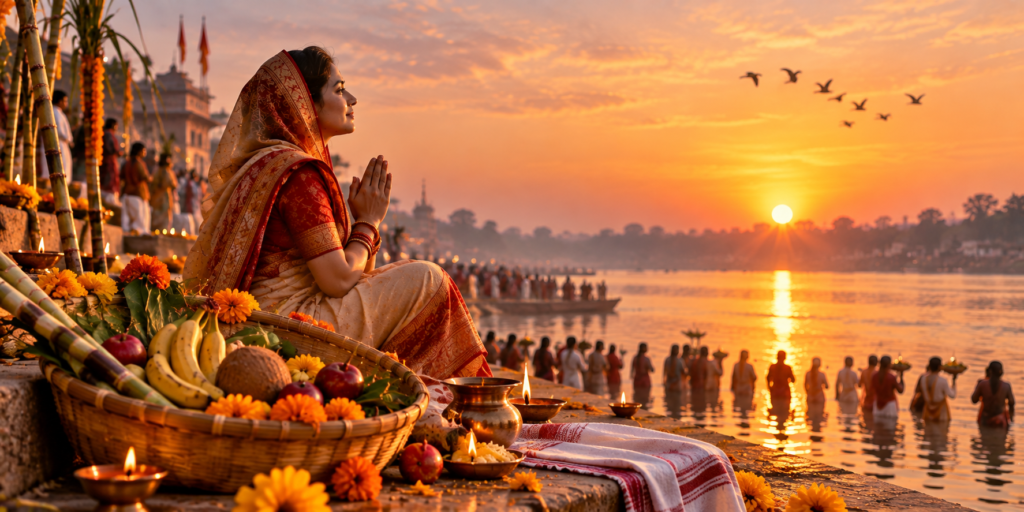
The devotees stand once again in the water, exhausted but peaceful.
And then, slowly, the darkness begins to disappear.
The first rays of the Sun touch the water.
Hands rise.
The soop is lifted.
Arghya is offered.
And the vrat comes to an end.
That is Chhath.
Not simply a festival of asking for blessings, but a festival of gratitude.
Gratitude for the Sun.
Gratitude for water.
Gratitude for food.
Gratitude for family.
And gratitude for another morning.
Chhath Puja 2026 will be observed from 13 to 16 November, with Sandhya Arghya on 15 November and Usha Arghya on 16 November.
If this story moved you, share it.
Explore more in Festival →