In today’s overstimulated world, silence has started feeling uncomfortable because we are constantly surrounded by noise—music, reels, podcasts, notifications, and endless distractions. The moment silence appears, many of us instinctively reach for our phones, not out of necessity, but because stillness feels unfamiliar. This blog explores why silence feels difficult, how modern life has conditioned our brains to avoid quiet moments, and why learning to sit with ourselves is essential for emotional balance and mental clarity. Through practical examples and simple habits, it explains how silence is not emptiness—but awareness, healing, and inner peace.
In a world full of noise, silence has started feeling strange.
🌿 Introduction: The Moment We Avoid Without Realizing

When was the last time you sat in complete silence…
without reaching for your phone?
No music.
No scrolling.
No background noise.
Just you and your thoughts.
Exactly.
For many people today, silence feels uncomfortable almost immediately.
Within seconds:
- We check notifications
- Open Instagram
- Play a podcast
- Turn on music “for background”
Not because we truly need stimulation—
but because we’ve forgotten how to simply be still.
🔊 Why Silence Feels Hard Today

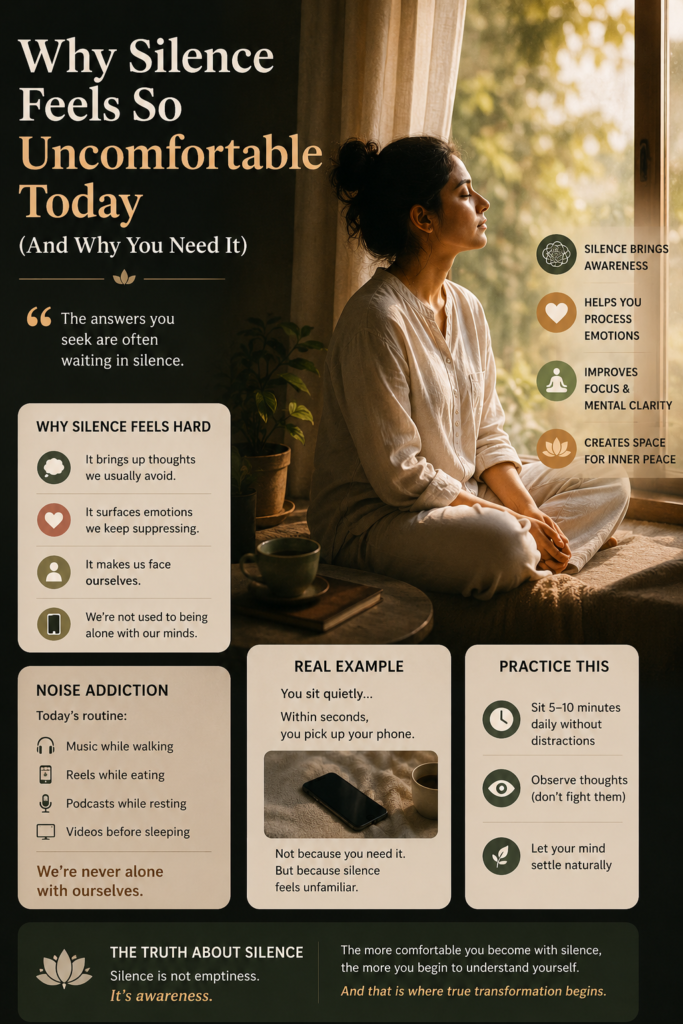
Silence feels difficult because silence brings things to the surface.
Things we usually avoid:
- Thoughts
- Emotions
- Unprocessed feelings
- Anxiety we kept distracting ourselves from
And modern life gives us endless ways to escape them.
💭 Real-Life Example
You’re waiting for an elevator.
It’s just 20 seconds.
But instead of standing quietly,
your hand automatically reaches for your phone.
Not because something urgent happened.
But because your mind has become uncomfortable with stillness.
💭 Another Everyday Example
You finish work after a tiring day.
Instead of resting quietly, you instantly:
- Open YouTube
- Start scrolling reels
- Play random videos
Hours pass.
Not because you were deeply entertained—
but because silence was harder to face.
📱 We’ve Become Addicted to Noise


Today’s routine looks like this:
🎧 Music while walking
📱 Reels while eating
🎙️ Podcasts while resting
📺 Videos before sleeping
We are constantly consuming something.
And slowly, we stop experiencing:
- Boredom
- Reflection
- Stillness
- Self-awareness
The problem isn’t technology itself.
The problem is:
👉 We no longer know how to sit alone with ourselves.
🧠 The Brain Gets Uncomfortable Without Stimulation


Your brain has adapted to constant stimulation.
So when silence appears, your mind reacts with:
- Restlessness
- Impatience
- The urge to escape
That’s why:
- A 10-minute silent walk feels “boring”
- Meditation feels difficult
- Sitting quietly feels unnatural
But silence isn’t the problem.
👉 The dependence on noise is.
🌿 The Truth About Silence


Silence is often misunderstood.
People think silence means:
- Emptiness
- Loneliness
- Doing nothing
But true silence is not emptiness.
👉 It is awareness.
In silence, you finally notice:
- What your mind is carrying
- What emotions you’ve been suppressing
- How exhausted your brain actually feels
And that awareness can feel uncomfortable at first.
But it is also healing.
🌱 What Silence Slowly Gives You
The more comfortable you become with silence,
the more you begin to experience:
- Clearer thinking
- Emotional balance
- Better focus
- Reduced anxiety
- Inner calm
💭 Real-Life Shift
A person who constantly needs noise:
- Feels restless alone
- Gets mentally exhausted quickly
- Avoids difficult emotions
But someone who practices silence:
- Responds instead of reacting
- Thinks more clearly
- Feels more emotionally grounded
Silence creates space between you and your mental chaos.
🛠️ How To Practice Silence (Without Making It Complicated)



You don’t need a mountain retreat.
Start small.
✔️ 1. Sit Quietly for 5–10 Minutes Daily
No music.
No scrolling.
No distractions.
Just sit.
At first, your mind will feel noisy.
That’s normal.
✔️ 2. Observe Thoughts (Don’t Fight Them)
Thoughts will come:
- Worries
- Memories
- Random emotions
Don’t suppress them.
Just notice them.
Silence is not about “stopping thoughts.”
It’s about becoming aware of them.
✔️ 3. Create Tiny Silent Moments
Try:
- Walking without headphones
- Eating one meal without screens
- Sitting quietly before sleeping
Small silent moments slowly retrain the mind.
✔️ 4. Don’t Escape Boredom Immediately
Boredom is important.
Because right after boredom…
👉 clarity often begins.
🌼 Closing Thought
Today, silence feels uncomfortable because we’ve become used to constant noise.
But the truth is:
The mind doesn’t heal in endless stimulation.
It heals in stillness.
And sometimes…
The answers you seek are quietly waiting in silence.

If this story moved you, share it.
Explore more in Digital Age Spirituality →